Commode
- Gallery: Europe 1600-1815, Room 1
- Maker: Georg Haupt (maker)
- Made in: Stockholm
- Date: 1779
- Object type: Commode
- Materials: Veneered in mahogany, satinwood, walnut and other woods, with gilt-bronze mounts and a marble top
- Style: Neoclassical
- Dimensions: Height 88.7 cm; Width 147 cm; Depth 66 cm
- Museum: V&A South Kensington
- Collection record: V&A website
- Image © Victoria and Albert Museum, London.
Listen to the free audio guide
In the museum now? Point your phone at the next object and hear its guide.
About this object
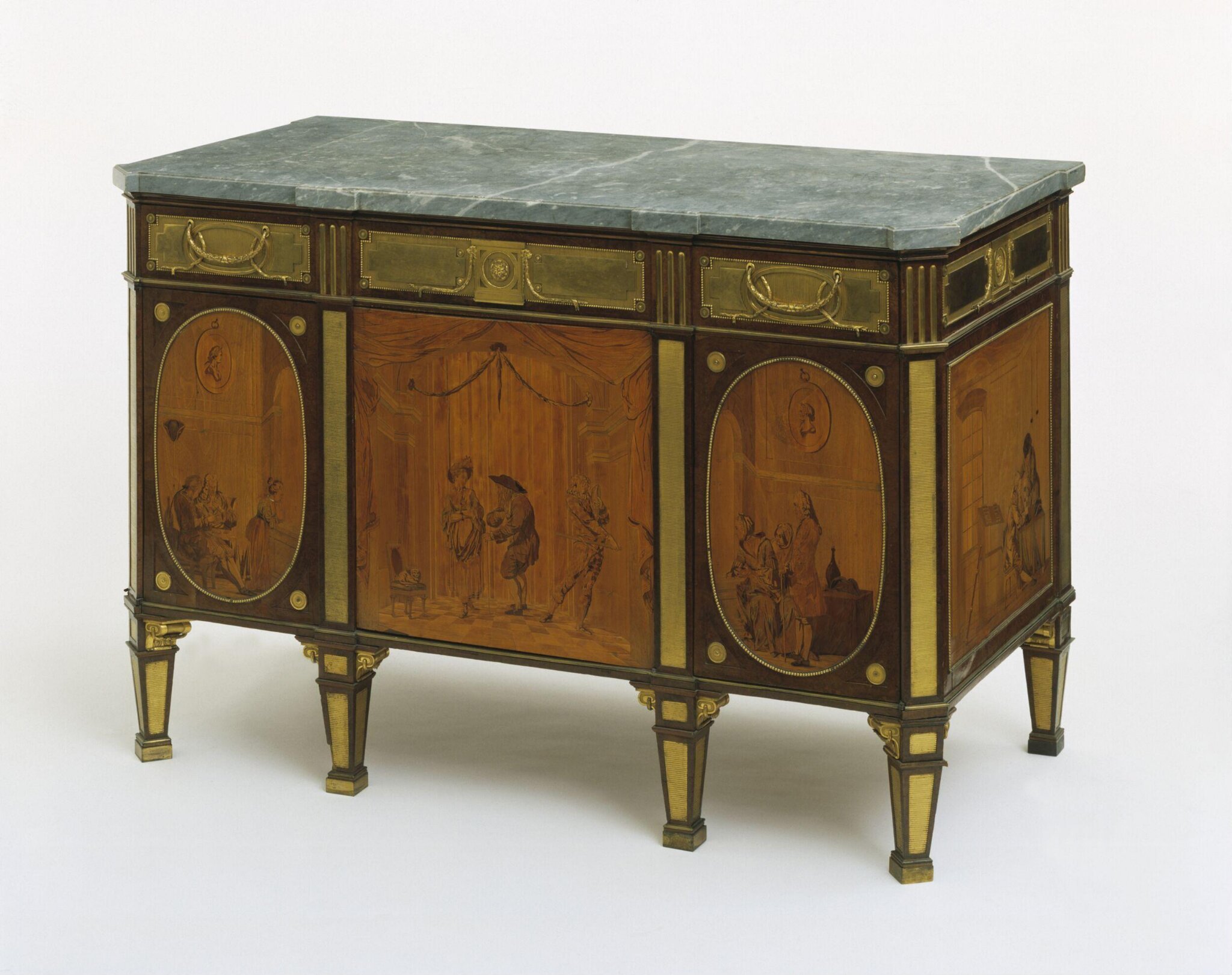
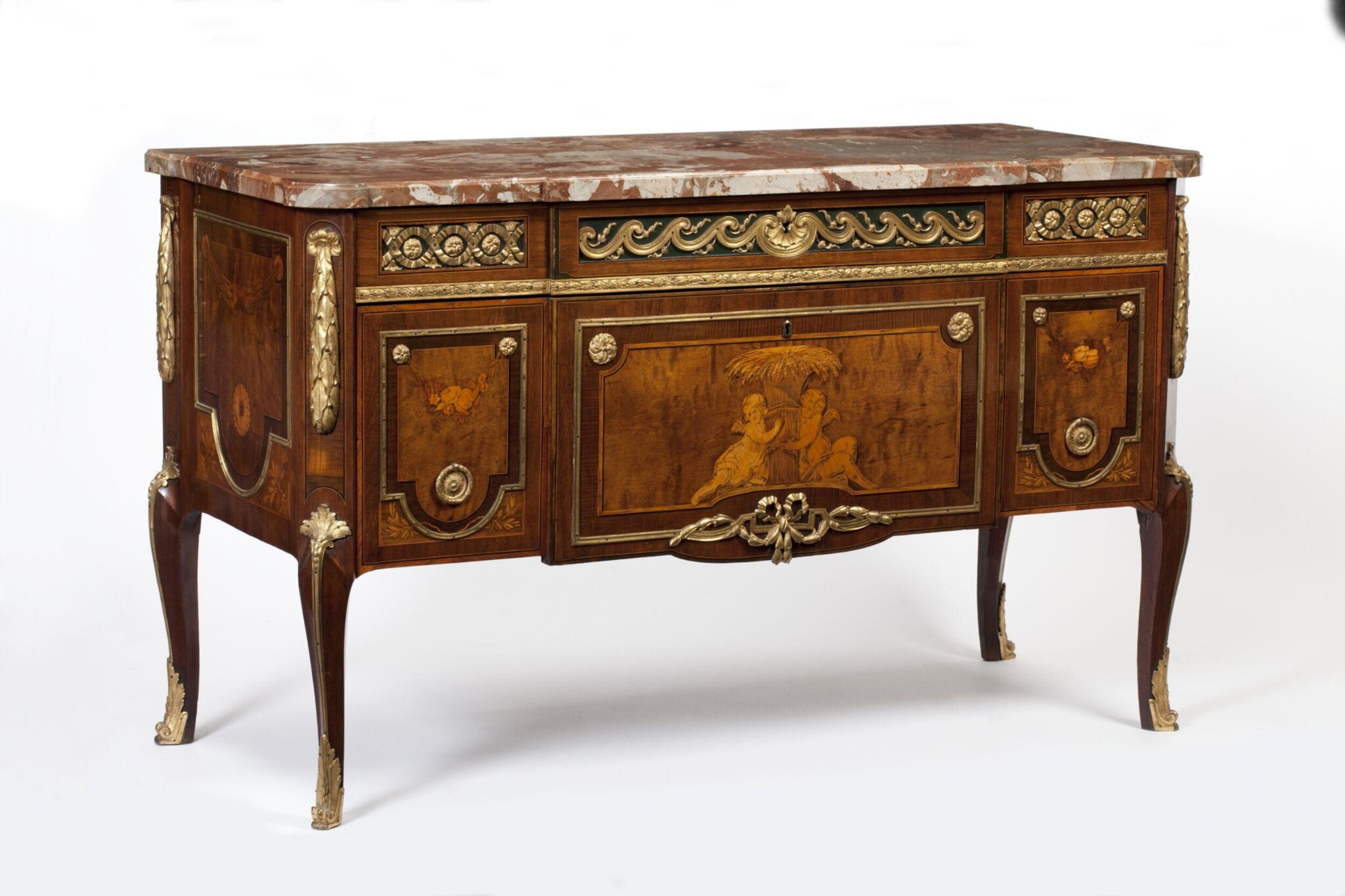
Before you is a striking commode made in Stockholm in 1779. It is veneered in rich woods like mahogany, walnut, and satinwood, and is topped with a slab of variegated red marble.
As you look closely at the front, notice the intricate marquetry. The central panel features a sheaf of corn supported by two small children, known as putti. This sheaf is actually a heraldic emblem of the Swedish royal family, suggesting this piece may have been made for a royal commission.
The design is decorated with gilded metal mounts in the form of classical laurel swags and a wave-like pattern called the Vitruvian scroll. While the rectangular body is Neoclassical, the curved legs are a lingering influence from the earlier Rococo style.
This work was created by Georg Haupt, who served as the cabinetmaker to the King of Sweden. Haupt trained in Paris and London, which is why this piece has such a bold, Parisian feel.
See it in person
Commode is on display in Europe 1600-1815, Room 1 at the V&A South Kensington on Cromwell Road, London — free to enter. Choose V&A South Kensington on audioguide.london and take a photo of it to hear this free audio guide in six languages — no app download needed.
New, in beta. V&A support has just launched and is still improving: 1,000 objects with audio so far, with more added all the time.