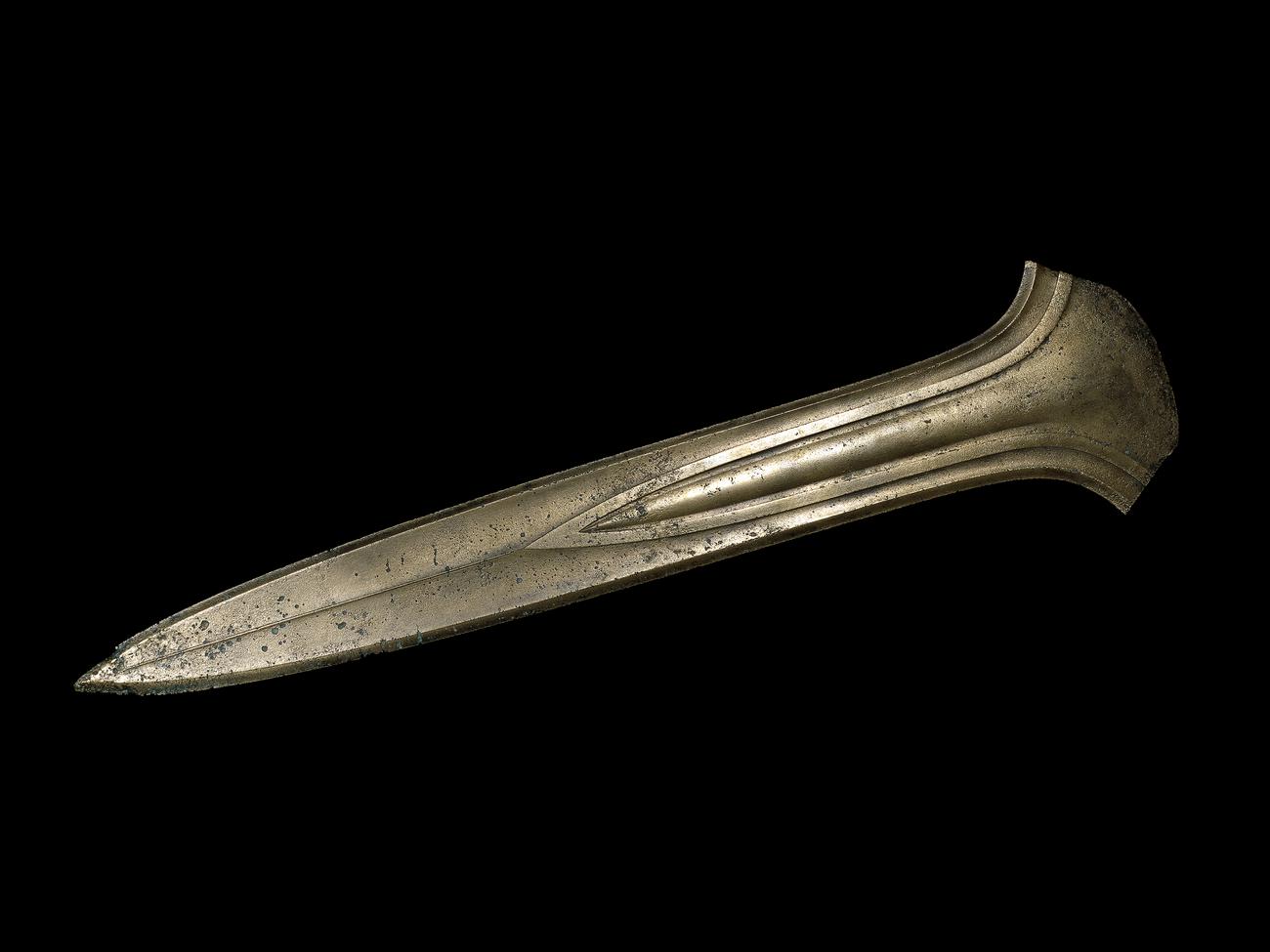
Ceremonial dagger from Oxborough
- Audio guide stop: 436
- Gallery: Room 51
- Culture: Middle Bronze Age
- Date: 1500BC-1300BC
- Object type: dirk
- Materials: copper alloy
- Museum number: 1994,1003.1
- Museum: The British Museum
- Collection record: British Museum website
- Image © The Trustees of the British Museum, shared under a CC BY-NC-SA 4.0 licence.
Listen to the free audio guide
About this object
In front of you is "The Oxborough Dirk," a striking copper alloy ceremonial dagger from the Middle Bronze Age, created between 1500 and 1300 BCE. Measuring over 700 millimeters in length and weighing nearly 2.4 kilograms, this is an exceptionally large and heavy blade for its time.
Careful examination shows that its blade edges are neatly formed but deliberately left blunt — not suitable for actual cutting. There are also no visible rivet holes at the butt end, where a handle might normally be attached. This strongly suggests the dagger was never meant for practical use.
Curators believe this finely crafted artifact may have had a ceremonial role or functioned as a valuable item for display or storage. Only two of this type have been found in Britain, and together with four others in the Netherlands and France, it belongs to a rare and closely related group known as the Plougrescant-Ommerschans type.
What you see today was discovered by chance in 1988, embedded in the peat-rich soil of My Lords Wood.
See it in person
Ceremonial dagger from Oxborough is on display in Room 51 at the British Museum on Great Russell Street, Bloomsbury, London — free to enter. Choose British Museum on audioguide.london and type its audio guide stop number, 436, from the gallery label, or take a photo of it, to hear this free audio guide in six languages — no app download needed.
New, in beta. British Museum support has just launched and is still improving: over 1,000 objects so far, with more added all the time.