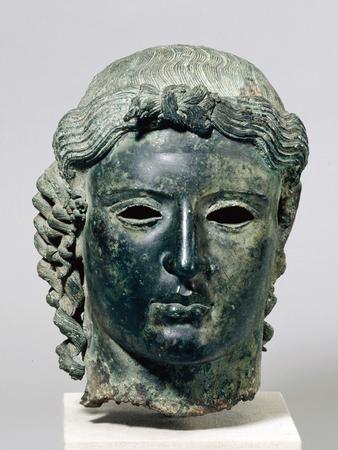
Bronze head of a young man
- Audio guide stop: 563
- Gallery: Room 72
- Culture: Classical Greek; Cypro-Classical I
- Made in: Cyprus (?); Greece (?)
- Date: 470BC-460BC (circa)
- Object type: statue
- Materials: bronze
- Museum number: 1958,0418.1
- Museum: The British Museum
- Collection record: British Museum website
- Image © The Trustees of the British Museum, shared under a CC BY-NC-SA 4.0 licence.
Listen to the free audio guide
About this object
This is "The Chatsworth Head," a bronze sculpture of a young man from around 470 to 460 BC. It was crafted using a hollow-cast technique and is larger than life size—about 32 centimeters tall. The figure has an impassive look and open eye sockets, which were once filled with another material, possibly ivory, to highlight the eyes.
Though only the head remains today, this work was once part of a full statue. Historians believe it could represent the Greek god Apollo or a worshipper. Stylistically, it reflects the early Classical Greek Severe Style.
The statue was discovered in Cyprus in 1836 and later entered the British Museum in 1958 after a long journey through private collections. Its influence on Cypriot sculpture is notable, particularly in limestone and terracotta works from local sanctuaries. Though of Classical Greek origin, this piece was created in a context where Greek and Cypriot artistic traditions began to blend.
See it in person
Bronze head of a young man is on display in Room 72 at the British Museum on Great Russell Street, Bloomsbury, London — free to enter. Choose British Museum on audioguide.london and type its audio guide stop number, 563, from the gallery label, or take a photo of it, to hear this free audio guide in six languages — no app download needed.
New, in beta. British Museum support has just launched and is still improving: over 1,000 objects so far, with more added all the time.