Beckford Candlesticks
- Gallery: Silver, Room 65
- Maker: Charles Aldridge (maker)
- Made in: London
- Date: 1787-1788
- Object type: Candlestick
- Materials: Silver-gilt, cast and chased
- Dimensions: Height 54.3 cm
- Museum: V&A South Kensington
- Collection record: V&A website
- Image © Victoria and Albert Museum, London.
Listen to the free audio guide
In the museum now? Point your phone at the next object and hear its guide.
About this object
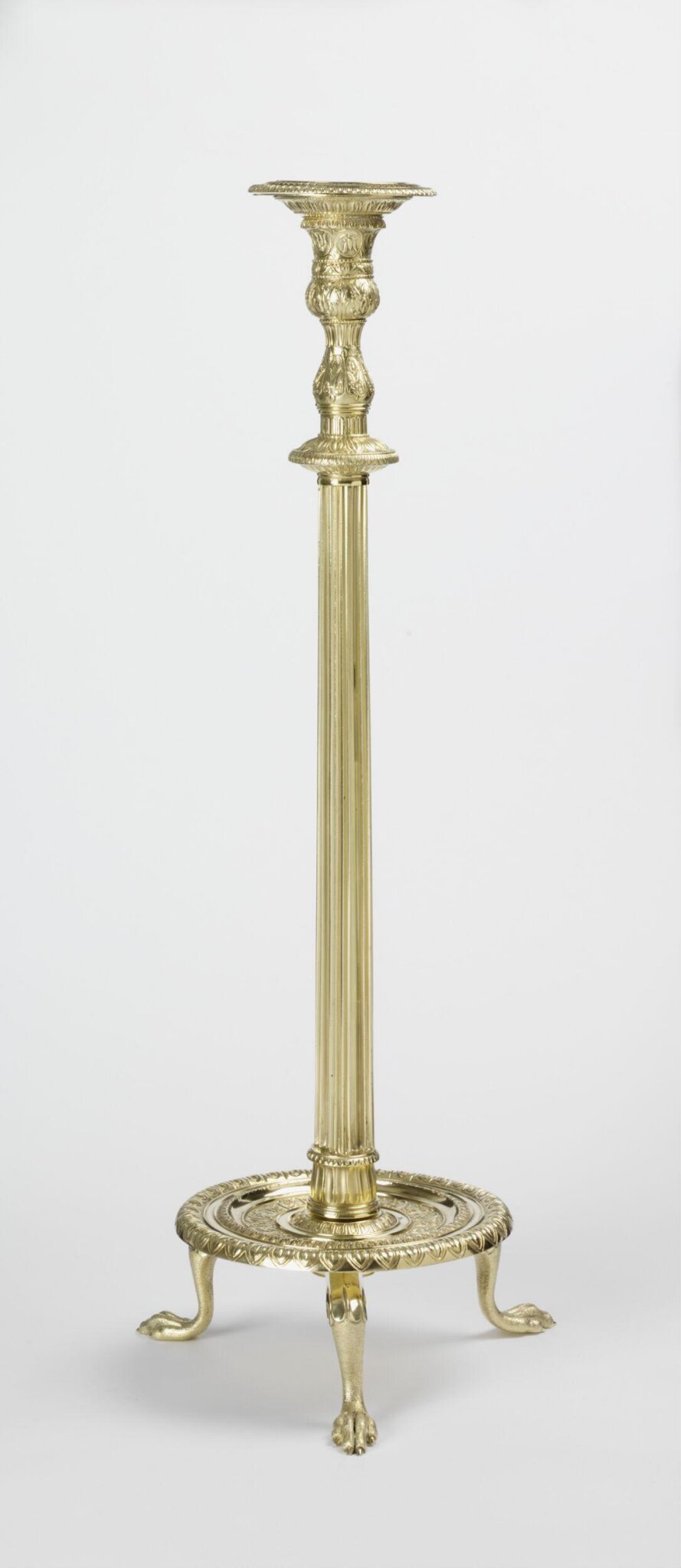
Before you are a pair of silver-gilt candlesticks, created in London between 1787 and 1788 by the goldsmith Charles Aldridge. These elegant pieces feature a highly detailed design, with stems and sockets decorated with chased bands of fluting and foliage. Look closely at the base, where the stem is supported by three matted claw feet.
These candlesticks were made for William Beckford, a man known for commissioning metalwork in historical styles to match his grand homes. They are actually inspired by a Roman bronze lamp stand that was excavated at Herculaneum. While the candlesticks follow the shape of that antique piece, they are smaller and feature lizard claws instead of the lion paws found on the original.
In 1822, these were used to create spectacular lighting effects in the Grand Drawing Room at Beckford's home, Fonthill Abbey. They were meant to harmonize perfectly with the architecture and interiors of his estate, marking an early example of the historical revival style.
See it in person
Beckford Candlesticks is on display in Silver, Room 65 at the V&A South Kensington on Cromwell Road, London — free to enter. Choose V&A South Kensington on audioguide.london and take a photo of it to hear this free audio guide in six languages — no app download needed.
New, in beta. V&A support has just launched and is still improving: 1,000 objects with audio so far, with more added all the time.