Baryton
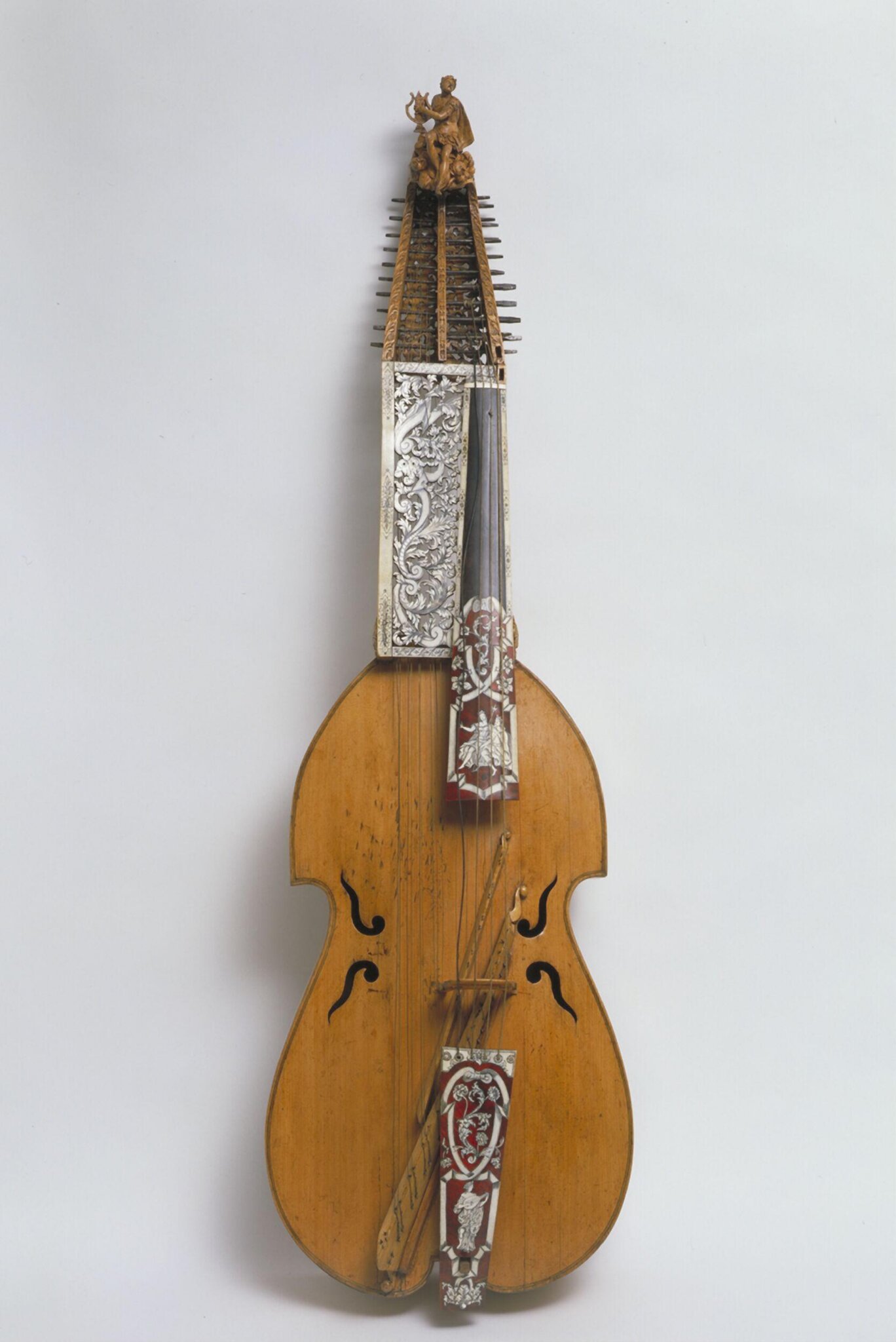
- Gallery: Europe 1600-1815, Room 5, The Friends of the V&A Gallery
- Maker: Jacques Sainprae (maker)
- Made in: Berlin
- Date: ca. 1720
- Object type: Baryton
- Materials: Carved sycamore, planed pine and sycamore, engraved ivory and tortoiseshell veneer
- Dimensions: Length (total) 133 cm; Length (belly) 70 cm; Depth 14 cm
- Museum: V&A South Kensington
- Collection record: V&A website
- Image © Victoria and Albert Museum, London.
Listen to the free audio guide
In the museum now? Point your phone at the next object and hear its guide.
About this object
Before you is a "Baryton", a unique central European string instrument made in Berlin around 1720. This particular example was crafted by Jacques Sainprae, a maker whose signature is found on this instrument, though it is the only one of his work known to have survived.
As you look closely at the details, notice the exquisite craftsmanship. The neck and fingerboard are decorated with a delicate veneer of engraved ivory and tortoiseshell, featuring a wavy floral pattern. At the very top, there is a finely carved figure of Orpheus playing a lyre.
The baryton was a bass instrument played with two sets of strings. A musician would use a bow on the upper strings, while the twenty-five sympathetic metal strings underneath provided a rich, vibrating harmony. This instrument enjoyed great popularity in central Europe, and the famous composer Joseph Haydn wrote many pieces for it, specifically for his patron, Prince Nikolaus Esterhazy, who was an enthusiastic player.
See it in person
Baryton is on display in Europe 1600-1815, Room 5, The Friends of the V&A Gallery at the V&A South Kensington on Cromwell Road, London — free to enter. Choose V&A South Kensington on audioguide.london and take a photo of it to hear this free audio guide in six languages — no app download needed.
New, in beta. V&A support has just launched and is still improving: 1,000 objects with audio so far, with more added all the time.