Aurelia
- Artist: Antonio Mancini
- Date: about 1906
- Medium: oil on canvas
- Museum: The National Gallery
- Collection record: The National Gallery website
Listen to the free audio guide
About this artwork
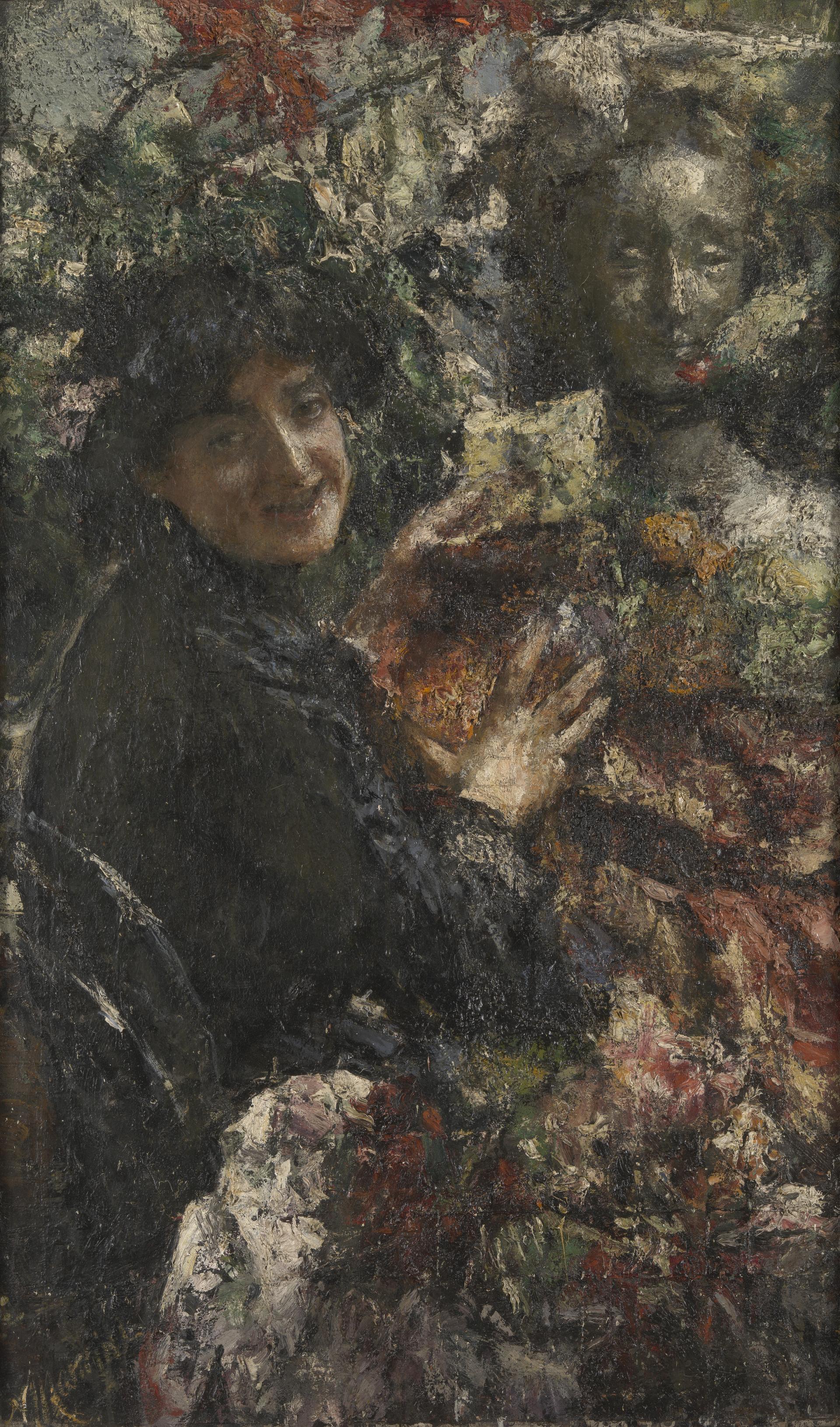
This is the "Aurelia" by Antonio Mancini. Painted in about 1906, it's a prime example of the artist's unique style and his fascination with capturing the essence of his models.
Here, we see Ciommi, known as La Cornacchia, dressed in sombre black, surrounded by a vibrant array of flowers and papers spilling out of the canvas. Her expression is one of delight and amusement, turning to the artist with a smile. The cause of her pleasure appears to be a new discovery - a white marble bust of a woman that seems to materialise at the upper right of the canvas.
The bust itself has sparked debate among art historians, with some suggesting it's an Italian Renaissance sculpture by Francesco Laurana, while others believe it may be a studio prop. Regardless of its origins, Mancini's use of it here creates an enigmatic image full of questions that he leaves unanswered.
Notice how the two contrasting heads - one static and made of marble, the other full of life and motion - are relatively thinly painted. The rest of the canvas, however, is imbued with a sense of movement and energy through thick layers of paint. This was a characteristic of Mancini's work throughout his career, admired by collectors for its intensely modern feel.
The painting itself has had a fascinating history, acquired by Hugh Lane in 1907 and later bequeathed to the National Gallery in 1917. Interestingly, there's another unfinished portrait of Ciommi on the reverse of the canvas, showcasing her as a tragic actress in a dramatic scene.
See it in person
Aurelia hangs in The National Gallery on Trafalgar Square, London — free to enter. Point your phone at any artwork there and audioguide.london plays a free audio guide in six languages — no app download needed.