Apollo flaying Marsyas
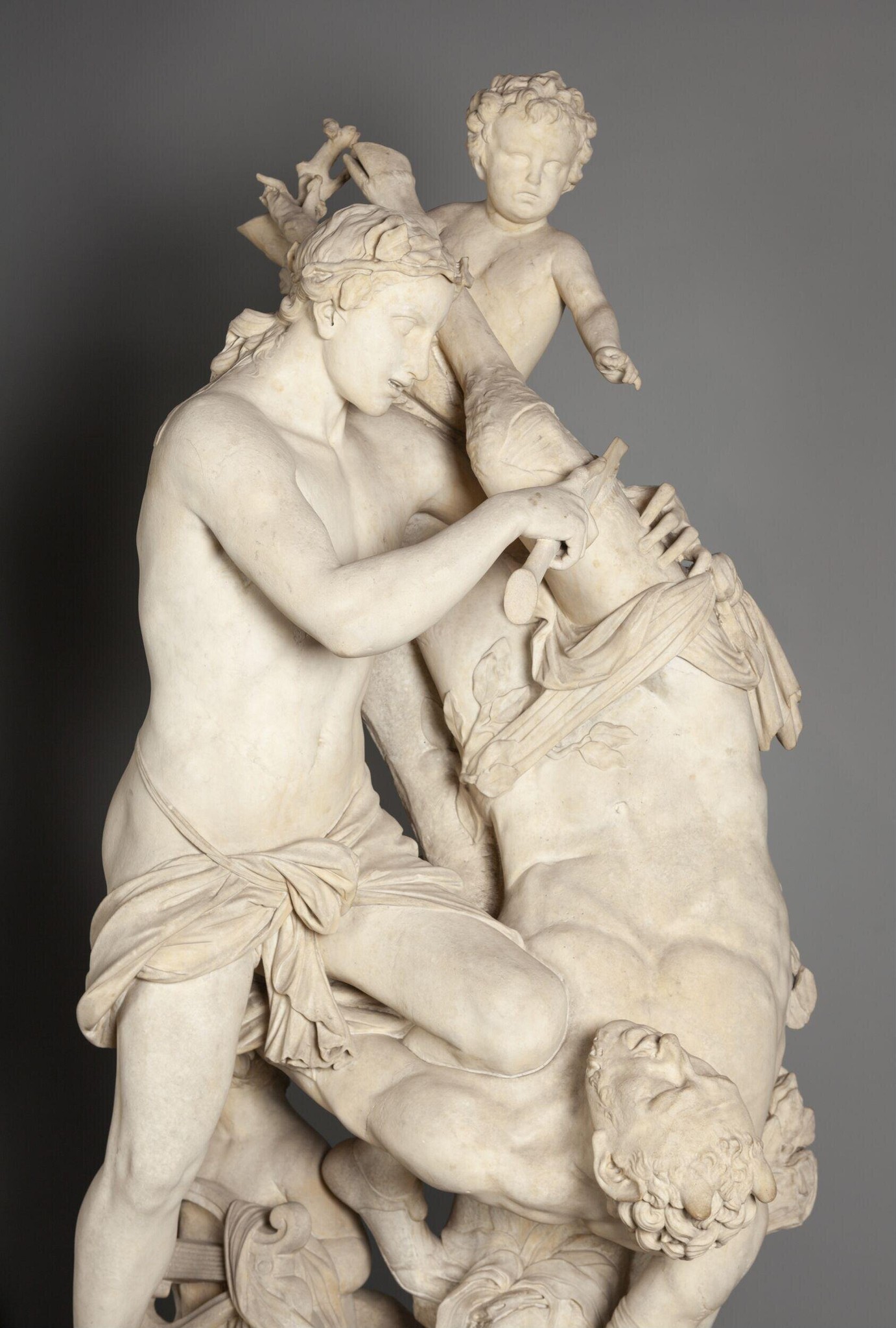
- Gallery: Sculpture, Room 23, The Dorothy and Michael Hintze Galleries
- Maker: Antonio Corradini (sculptor)
- Made in: Italy
- Date: ca. 1719-23
- Object type: Statue
- Materials: Carved marble
- Style: Baroque
- Dimensions: Height (object and plinth) 1494 in; Weight (object only) 1088 kg; Weight (plinth ballast) 172 kg
- Museum: V&A South Kensington
- Collection record: V&A website
- Image © Victoria and Albert Museum, London.
Listen to the free audio guide
In the museum now? Point your phone at the next object and hear its guide.
About this object
Before you is the marble sculpture "Apollo flaying Marsyas" by Antonio Corradini. This work captures one of the most disturbing scenes from classical mythology. It depicts the god Apollo skinning the satyr Marsyas alive as a penalty for losing a musical contest.
As you look closely, notice how Marsyas is shown upside-down, while Apollo begins to peel away his skin. You can see two small putti nearby; one sits by Apollo's lyre on the ground, while the other looks over the god's shoulder.
Created in Italy around 1719 to 1723, this piece is part of a series of garden sculptures. It was originally intended for the gardens of Augustus the Strong, the King of Poland, in Dresden. Corradini was a master of marble, and while his style is rooted in classical tradition, it also features a sense of lightness and movement perfect for an outdoor setting.
See it in person
Apollo flaying Marsyas is on display in Sculpture, Room 23, The Dorothy and Michael Hintze Galleries at the V&A South Kensington on Cromwell Road, London — free to enter. Choose V&A South Kensington on audioguide.london and take a photo of it to hear this free audio guide in six languages — no app download needed.
New, in beta. V&A support has just launched and is still improving: 1,000 objects with audio so far, with more added all the time.