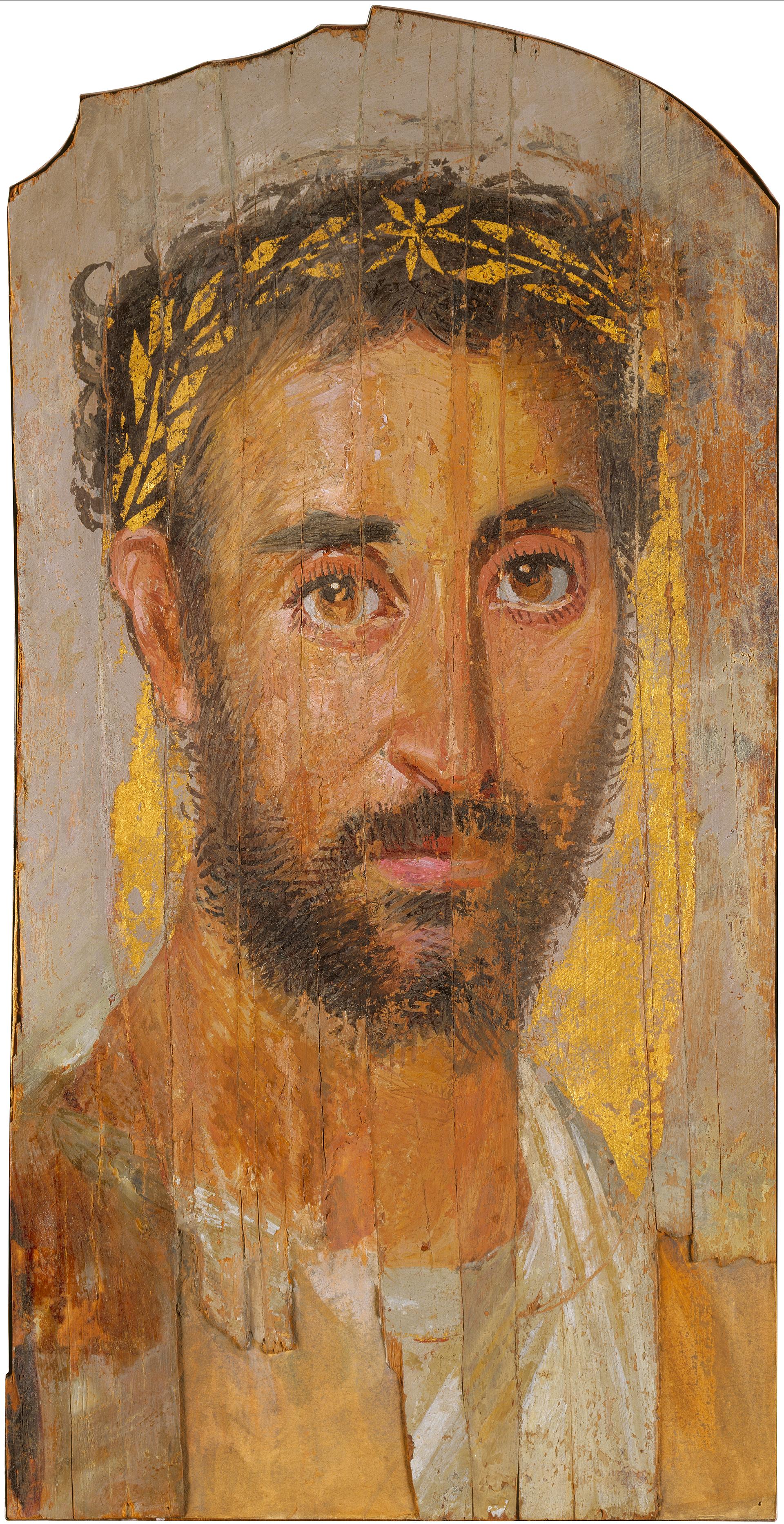
A Man with a Wreath
- Artist: Greco-Roman
- Date: probably 2nd to 3rd century
- Medium: encaustic on wood
- Museum: The National Gallery
- Collection record: The National Gallery website
Listen to the free audio guide
About this artwork
This is "A Man with a Wreath" painted in the Greco-Roman style. The subject of the painting is a middle-aged man who directly confronts the viewer through his large, heavy-lidded eyes. His portraitist has taken great care to paint every hair of his beard and moustache so that they appear coarse and wiry.
A gold wreath with leaves and a flower at its centre garlands his curly hair. You can see folds of cream-coloured drapery curving around his neck, crossing diagonally at his chest. At the far left of his tunic is a deep red clavus, a coloured stripe that denoted status in Rome.
The painting was probably commissioned at the man's death and then set into the case containing his mummified body. Only the wealthiest citizens would have been able to afford this kind of burial rite and image. The use of limewood for the panel, which is not native to Egypt, reflects the cosmopolitan nature of the image.
The portrait was excavated from a burial chamber in Er-Rubaiyat in the Faiyum region of Egypt, south-west of Cairo. It's a remarkable piece that provides insight into the lives of the wealthy during this time period.
See it in person
A Man with a Wreath hangs in The National Gallery on Trafalgar Square, London — free to enter. Point your phone at any artwork there and audioguide.london plays a free audio guide in six languages — no app download needed.