Philip IV on Horseback
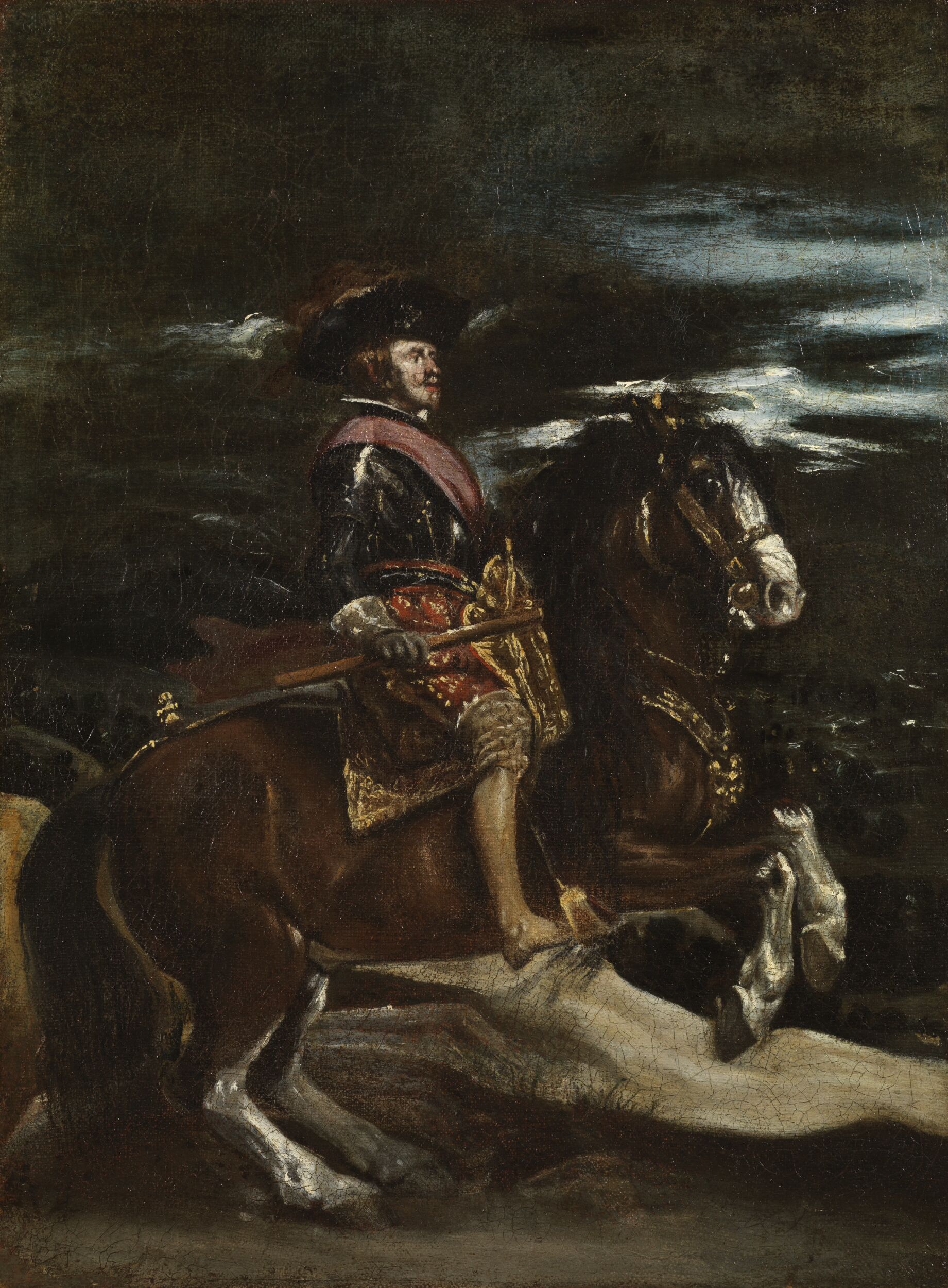
- Artist: Diego Velázquez
- Date: (circa) 1640 - 1660
- Medium: oil on canvas
- Museum: The Courtauld Gallery
- Collection record: The Courtauld Gallery website
Listen to the free audio guide
About this artwork
This is the "Philip IV on Horseback" by Diego Velázquez. The canvas captures the Spanish king in full regalia, mounted on a dramatic, rearing horse that dominates the composition. Velázquez uses a tight, almost theatrical framing, placing the monarch in a dramatic, shallow background that keeps all attention on the subject.
What’s striking is how the artist balances realism and grandeur. The king’s face is rendered with subtle, almost imperceptible brushwork, showing the faint tremor of age behind the bold, ceremonial beard. His costume is richly detailed, from the jeweled cuirass to the embroidered cape, all painted with a controlled, layered technique that gives depth without excess. The horse, meanwhile, is depicted in motion, with the rider’s arm extended, his hand steadying the reins. The movement is captured by a slight blur of the horse’s mane and the rippling fabric, hinting at the velocity and energy of the moment.
Velázquez’s palette here is restrained, dominated by earth tones, muted golds, and dark greens that convey the solemnity of a royal procession. The light falls from the side, highlighting the texture of the metal and the subtle folds of the fabric. This lighting choice underscores the presence of power while maintaining a naturalistic tone.
Created between 1640 and 1660, this work sits squarely in the Baroque period, reflecting the Spanish court’s penchant for dramatic, yet controlled portraiture. It’s a testament to Velázquez’s mastery in blending courtly pomp with an intimate, almost candid, visual narrative.
See it in person
Philip IV on Horseback hangs in The Courtauld Gallery at Somerset House, London. Point your phone at any artwork there and audioguide.london plays a free audio guide in six languages — no app download needed.