James Barry; Dominique Lefèvre; James Paine the Younger
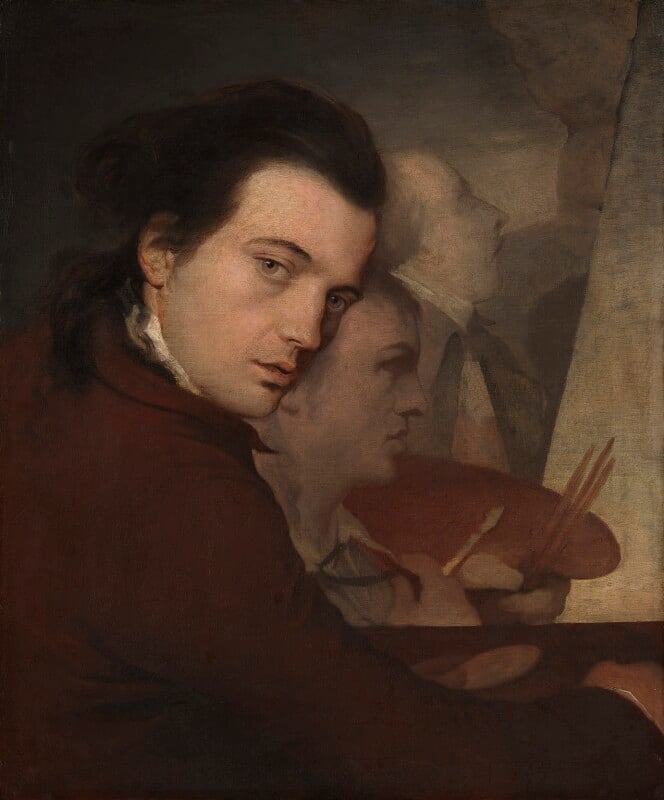
- Artist: James Barry
- Date: circa 1767
- Medium: oil on canvas
- Dimensions: 23 3/4 in. x 19 3/4 in. (605 mm x 500 mm)
- Portrays: James Barry, Dominique Lefèvre, James Paine the Younger
- Museum: The National Portrait Gallery
- Collection record: The National Portrait Gallery website
Listen to the free audio guide
About this artwork
In this oil on canvas, you see Irish artist James Barry looking straight at the viewer, his brush lightly touching a large sheet of paper or perhaps a plaster study. In front of him, almost overlapping his own head, is a marble torso—the Belvedere Torso—which Barry believed to be the finest surviving sculpture from classical antiquity. The detail of the carved rib cage and the subtle shadows on its surface show careful observation.
Behind Barry, in softer light, are two fellow students: Dominique Lefèvre, a French painter, and James Paine the Younger, an architect. Their figures suggest a small studio circle, with a book or sketch pad hinting at collaborative study. The overall composition feels intimate yet scholarly; you can see faint lines of his own hand as if he is still drawing on the canvas itself.
Created around 1767, this work reflects Barry’s time in Rome and his idealistic approach to art—he painted himself with a model, a subject, and an attentive group of peers.
See it in person
James Barry; Dominique Lefèvre; James Paine the Younger is in the collection of The National Portrait Gallery at St Martin's Place, London — free to enter. Point your phone at any artwork there and audioguide.london plays a free audio guide in six languages — no app download needed.