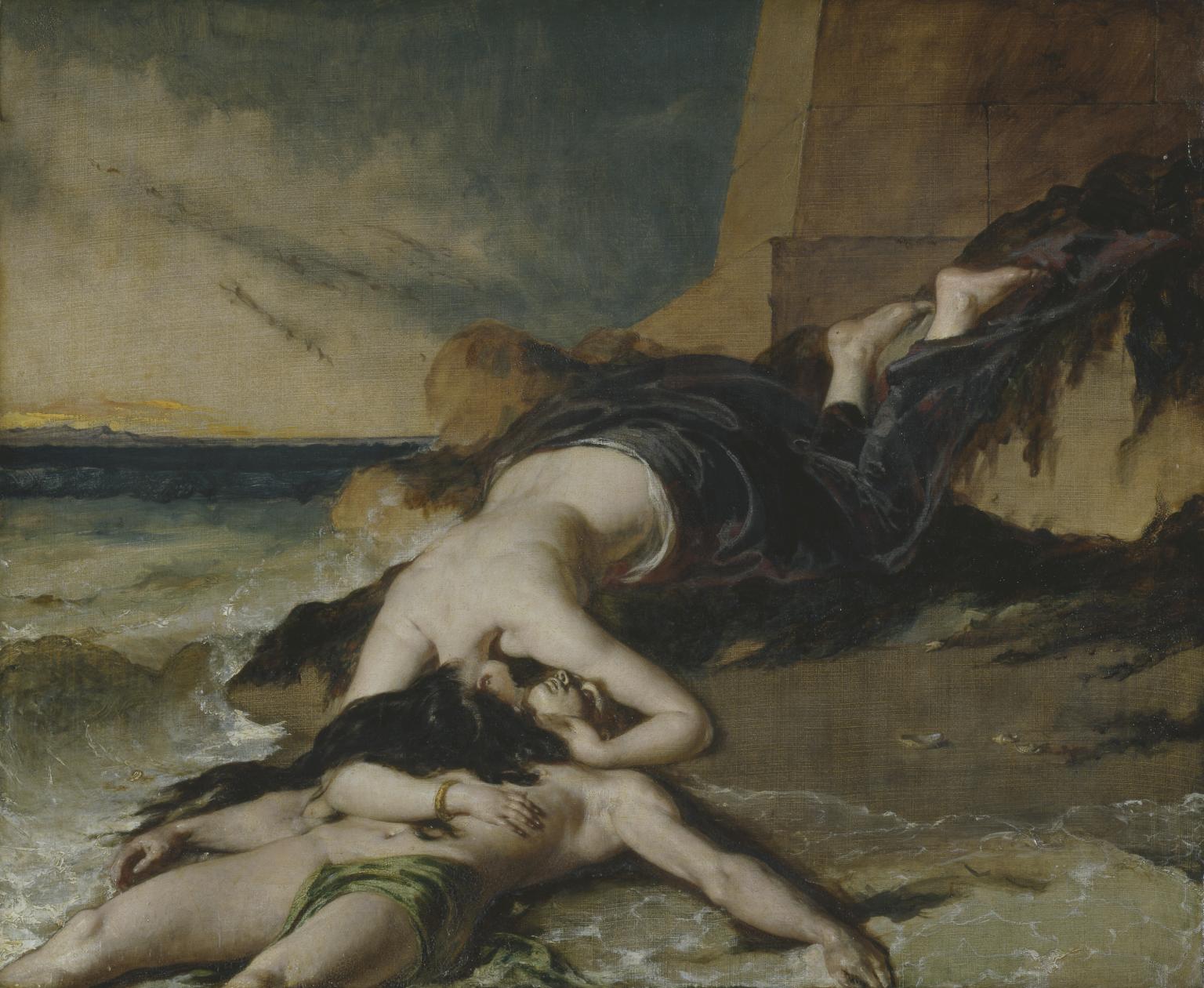
Hero, Having Thrown herself from the Tower at the Sight of Leander Drowned, Dies on his Body
- Artist: William Etty
- Date: exhibited 1829
- Medium: Oil paint on canvas
- Dimensions: support: 750 x 925 x 20 mm
- Museum: Tate Britain
- Collection record: Tate Britain website
Listen to the free audio guide
In the museum now? Point your phone at the next artwork and hear its guide.
About this artwork
This is the “Hero, Having Thrown herself from the Tower at the Sight of Leander Drowned, Dies on his Body” by William Etty, painted in 1829. Etty captures the tragic ending of the ancient lovers Hero and Leander. In myth, Leander swims across the Hellespont each night to reach Hero’s tower, but a storm takes his life. Hero, heartbroken, leaps from the tower to join him. Etty dramatizes this moment with semi‑naked bodies that are foreshortened, pulling the viewer into the scene’s raw emotion. The rugged coastal background and rolling waves emphasize the storm’s fury and the lovers’ desperate escape. The work exemplifies Romantic painters’ fascination with mythic passion and intense feeling. Etty’s use of bright, contrasting colors and rapid brushwork gives the canvas a kinetic energy that matches the narrative’s urgency. The painting was exhibited at the Royal Academy in 1829 and has since become a key example of early nineteenth‑century British Romanticism, showcasing both the artist’s skill in rendering the human form and the era’s preoccupation with love, loss, and the sublime forces of nature.
See it in person
Hero, Having Thrown herself from the Tower at the Sight of Leander Drowned, Dies on his Body is in the collection of Tate Britain on Millbank, London — free to enter. Point your phone at any artwork there and audioguide.london plays a free audio guide in six languages — no app download needed.