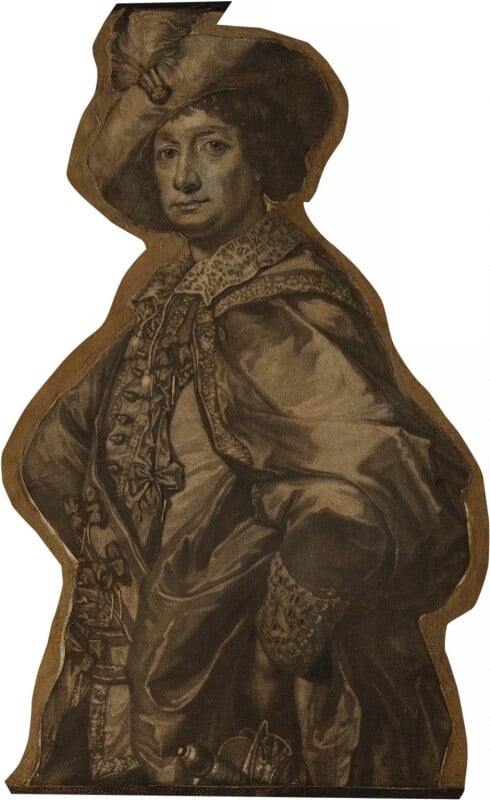
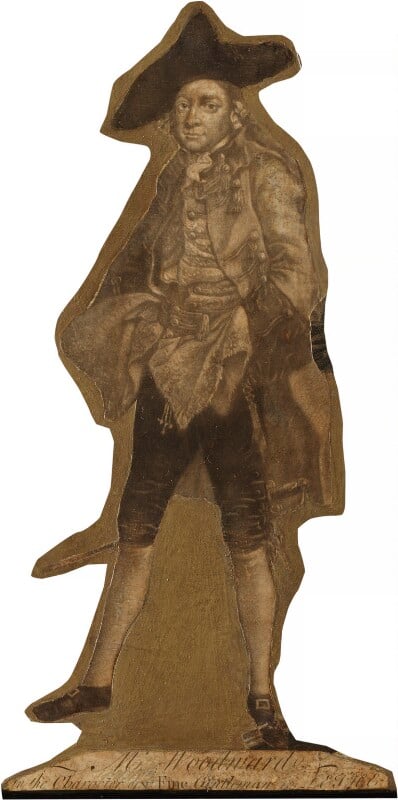
Henry Woodward as the Fine Gentleman in 'Lethe'
- Artist: Francis Hayman
- Artist: James Macardell
- Date: circa 1725-1750
- Medium: mezzotint
- Dimensions: Long Term Loan
- Portrays: Henry Woodward
- Museum: The National Portrait Gallery
- Collection record: The National Portrait Gallery website
Listen to the free audio guide
About this artwork
This is “Henry Woodward as the Fine Gentleman in ‘Lethe’.” You can see a dignified actor—his face framed by a brimmed hat and polished cuffs—sitting upright, his expression calm yet alert. The mezzotint technique gives the image a subtle tonal depth; shadows fall gently across the suit, while highlights gleam on the polished brocade of his jacket. Notice the fine linework that captures every detail: the buttons on his vest, the careful folds in his sleeve, even the faint outline of a dagger resting at his side.
The print is based on a portrait by Francis Hayman, made sometime between 1725 and 1750, and later reproduced as a mezzotint engraving by James Macardell. Both artists were active in early eighteenth‑century England; Hayman was known for his elegant court portraits, while Macardell specialized in mezzotints that brought painted scenes into the hands of wider audiences.
In this piece we see an actor portrayed as a “fine gentleman” of the period—his costume reflecting the fashionable attire of London’s theatrical circles—and we also catch a glimpse of early printmaking, where engraving added texture and contrast to bring a painted image to life in print form.
See it in person
Henry Woodward as the Fine Gentleman in 'Lethe' is in the collection of The National Portrait Gallery at St Martin's Place, London — free to enter. Point your phone at any artwork there and audioguide.london plays a free audio guide in six languages — no app download needed.