George Chinnery
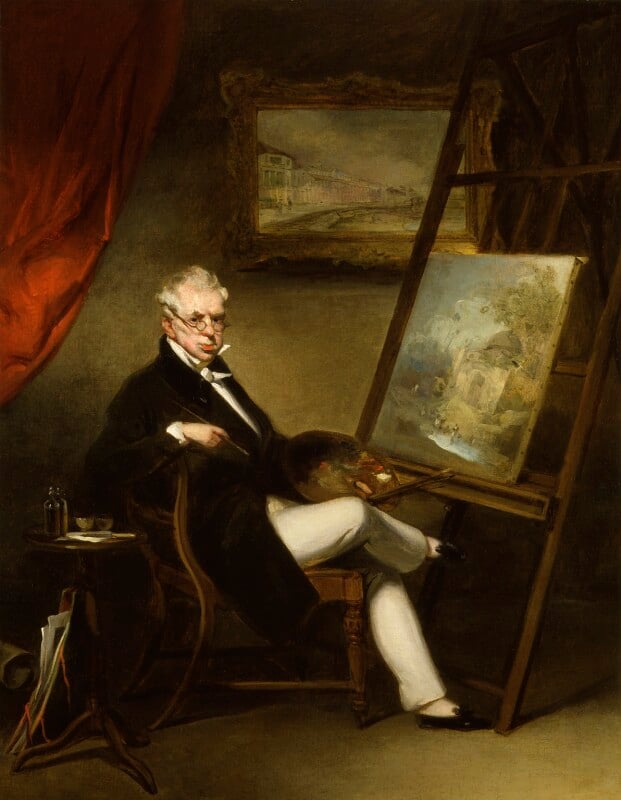
- Artist: George Chinnery
- Date: circa 1840
- Medium: oil on canvas
- Dimensions: 28 in. x 21 1/4 in. (711 mm x 540 mm)
- Portrays: George Chinnery
- Museum: The National Portrait Gallery
- Collection record: The National Portrait Gallery website
Listen to the free audio guide
About this artwork
In front of you sits George Chinnery, painter of Bengal scenes, in his own oil portrait from around 1840. He stands in plain attire, a brush tucked into his belt, eyes steady on the canvas before him. The easel holds another painting—his depiction of a lush Bengal landscape—with green fields, distant trees and a river curling to the horizon. The artist looks directly at us, almost as if he invites us to view his work.
Chinnery used this double portrait to show his colonial practice. After moving to Calcutta in 1802, he became the leading British painter there. In 1825 he fled to Portuguese‑controlled Macau, where Chinese merchant patrons supported him. By displaying a Bengal landscape on his easel he proved that the exotic scenery of India could be captured with Western oil techniques.
The work is finished in rich oils on canvas. The careful brushwork gives depth to the light sky and the detailed foliage, while Chinnery’s own face reflects the calm confidence of an artist who had travelled far and painted even further.
See it in person
George Chinnery is in the collection of The National Portrait Gallery at St Martin's Place, London — free to enter. Point your phone at any artwork there and audioguide.london plays a free audio guide in six languages — no app download needed.