Ganga Singh, Maharaja of Bikaner
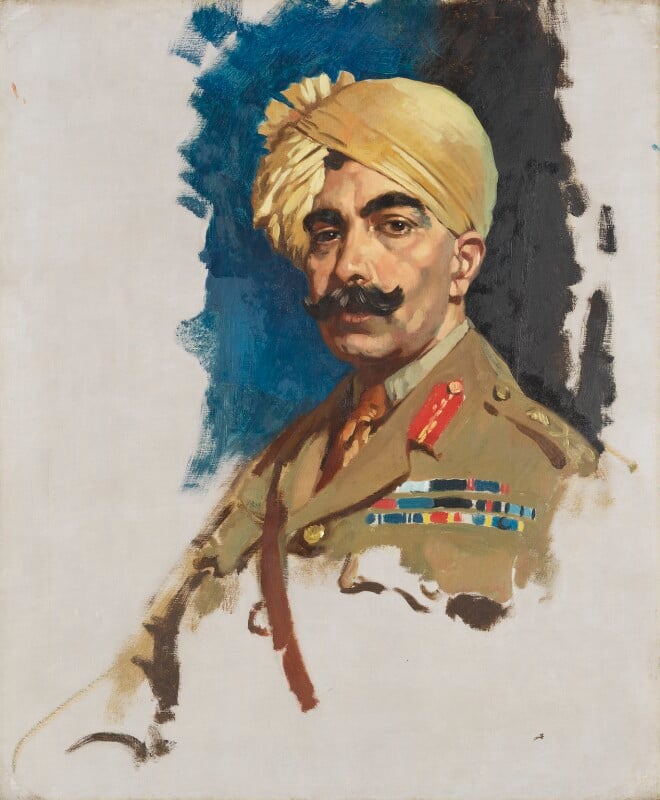
- Artist: Sir William Orpen
- Date: 1919
- Medium: oil on canvas
- Dimensions: 30 in. x 25 in. (762 mm x 635 mm)
- Portrays: Ganga Singh, Maharaja of Bikaner
- Museum: The National Portrait Gallery
- Collection record: The National Portrait Gallery website
Listen to the free audio guide
About this artwork
In front of you is “Ganga Singh, Maharaja of Bikaner,” an oil on canvas painted by Sir William Orpen in 1919. The portrait shows the ruler in full regalia: a richly embroidered turban, a jeweled headband and his ceremonial hat, all rendered with meticulous brushwork that gives depth to the fabric folds.
Orpen’s study comes from his larger project of painting delegates at the Imperial Peace Conference that closed World War I. He produced several group portraits for that event, and this one is a snapshot of the Maharaja himself before he returned to his kingdom in Rajputana (now Rajasthan).
Ganga Singh had been made a British Army General—the first Indian officer to reach that rank—and he played a key role as a delegate on behalf of India at the conference. The painting therefore captures both his personal stature and the moment when, for the first time, an Indian ruler could appear before the world’s leaders in London.
The canvas measures 30 in by 25 in, a modest size that still allows Orpen to show subtle details: the gleam of his silver waistcoat, the slight tilt of his head, and the dignified expression that speaks of duty and pride.
See it in person
Ganga Singh, Maharaja of Bikaner is in the collection of The National Portrait Gallery at St Martin's Place, London — free to enter. Point your phone at any artwork there and audioguide.london plays a free audio guide in six languages — no app download needed.