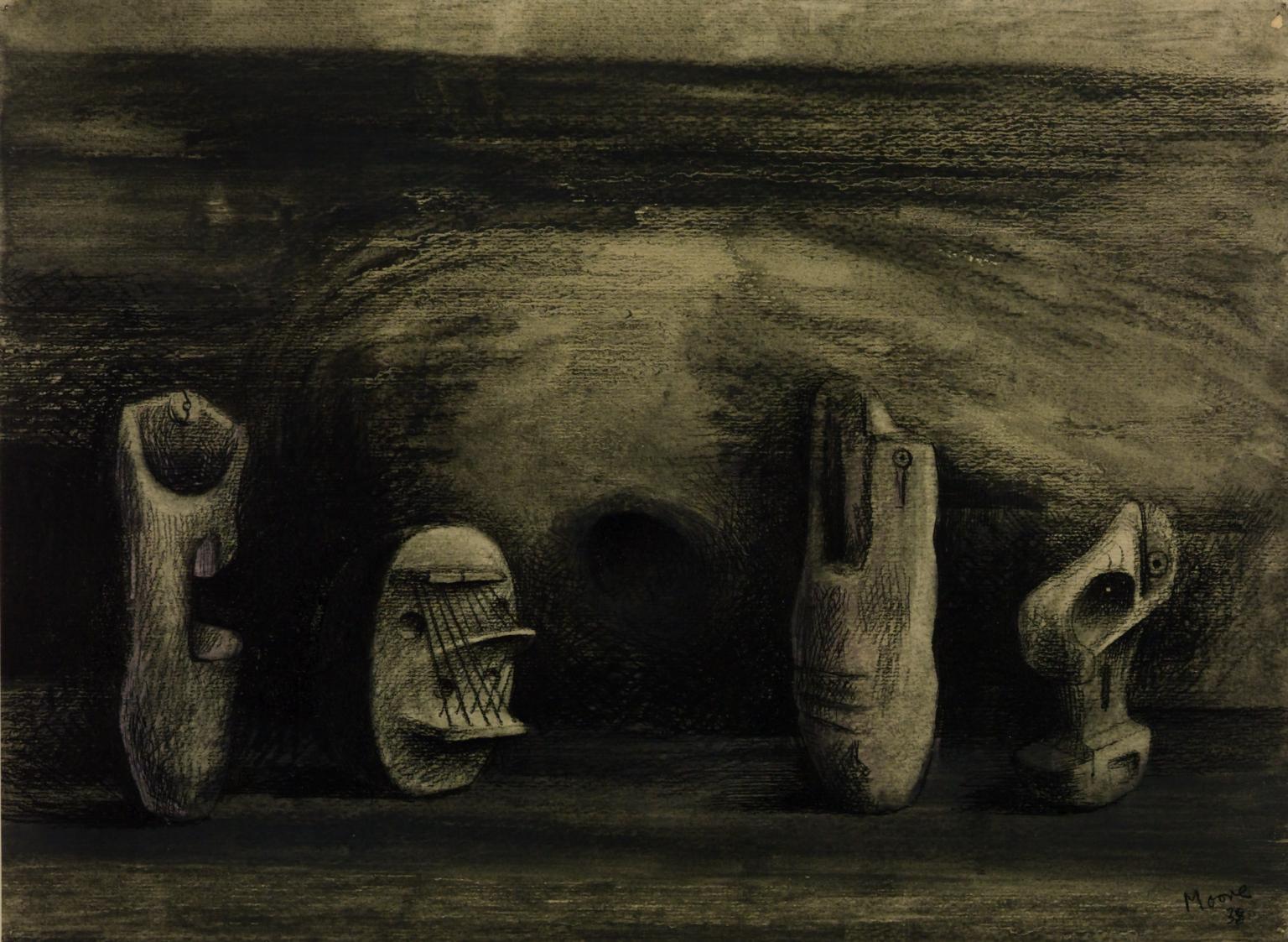
Four Forms, drawing for a Sculpture
- Artist: Henry Moore OM, CH
- Date: 1938
- Medium: Chalk, ink and watercolour on paper
- Dimensions: support: 279 x 381 mm
- Museum: Tate Britain
- Collection record: Tate Britain website
Listen to the free audio guide
In the museum now? Point your phone at the next artwork and hear its guide.
About this artwork
This is the “Four Forms” drawing for a sculpture by Henry Moore. Created in 1938, the work is a 279 × 381 mm study in chalk, ink and watercolour. It shows a series of abstract, sculptural outlines set against a loose landscape backdrop, a hallmark of Moore’s explorations in the late 1930s.
Moore himself wrote that he used drawings mainly “as a help towards making sculpture – a means of generating ideas…and a way of sorting out ideas and developing them.” In “Four Forms” the second figure from the left is a direct sketch of the small elm‑wood “Head” he made that same year, tying the drawing directly to a forthcoming three‑dimensional work. The other shapes hint at the irregular, non‑representational forms that would become central to his public monuments.
The drawing was purchased in 1959 from the executors of E. C. Gregory and has since appeared in numerous shows, from the Mayor Gallery in London to exhibitions across Europe and North America. Its modest scale belies its importance as a window into Moore’s creative process, revealing how a simple line could translate into monumental stone and bronze.
See it in person
Four Forms, drawing for a Sculpture is in the collection of Tate Britain on Millbank, London — free to enter. Point your phone at any artwork there and audioguide.london plays a free audio guide in six languages — no app download needed.