Flatford Mill (‘Scene on a Navigable River’)
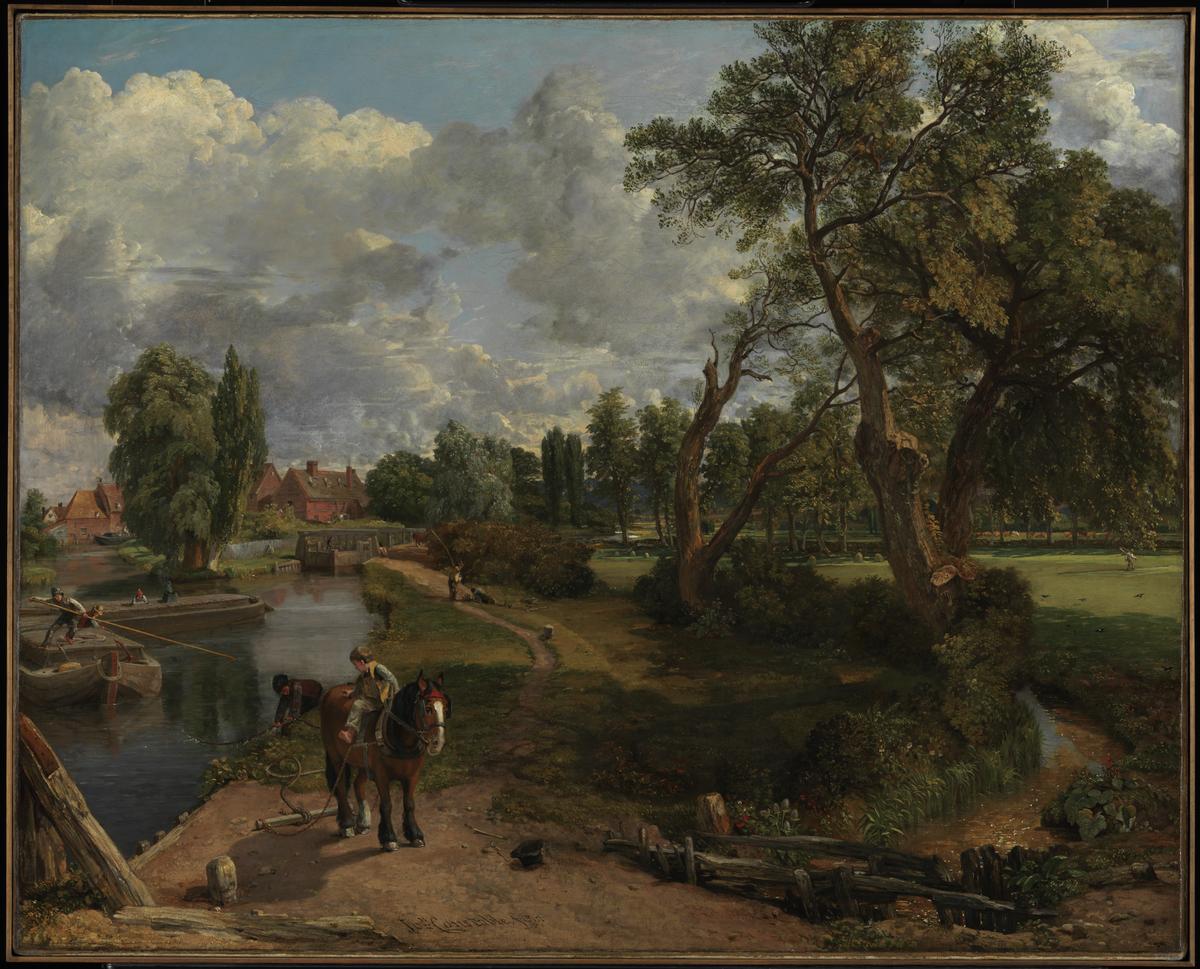
- Artist: John Constable
- Date: 1816–7
- Medium: Oil paint on canvas
- Dimensions: support: 1016 x 1270 mm
- Museum: Tate Britain
- Collection record: Tate Britain website
Listen to the free audio guide
About this artwork
This is the “Flatford Mill (Scene on a Navigable River)” by John Constable. It’s a snapshot of working life at his father’s watermill on the River Stour in Suffolk. The canvas shows a barge being disconnected from a tow horse, the rope cut in the mud, as it prepares to be “poled” under Flatford Bridge. The lower left corner captures that moment of quiet transition, while a quiet scene of two boys in the distance adds a human touch.
What makes this piece stand out is that it was Constable’s largest canvas painted outdoors. He started it on site in 1816–17, then carried it back to his studio where he made dramatic changes: a horse on the towpath was replaced by the two boys we see now, and he repainted the tops of the trees and the sky for its second showing at the British Institution in 1818.
You can spot the artist’s signature in the bottom centre, written so that it looks like it’s been carved into the dirt. The work was exhibited at the Royal Academy in 1817, then again in 1818, and was bequeathed to the Tate in 1888. It’s a lively glimpse of early nineteenth‑century river commerce, rendered with Constable’s characteristic attention to light and atmosphere.
See it in person
Flatford Mill (‘Scene on a Navigable River’) is in the collection of Tate Britain on Millbank, London — free to enter. Point your phone at any artwork there and audioguide.london plays a free audio guide in six languages — no app download needed.