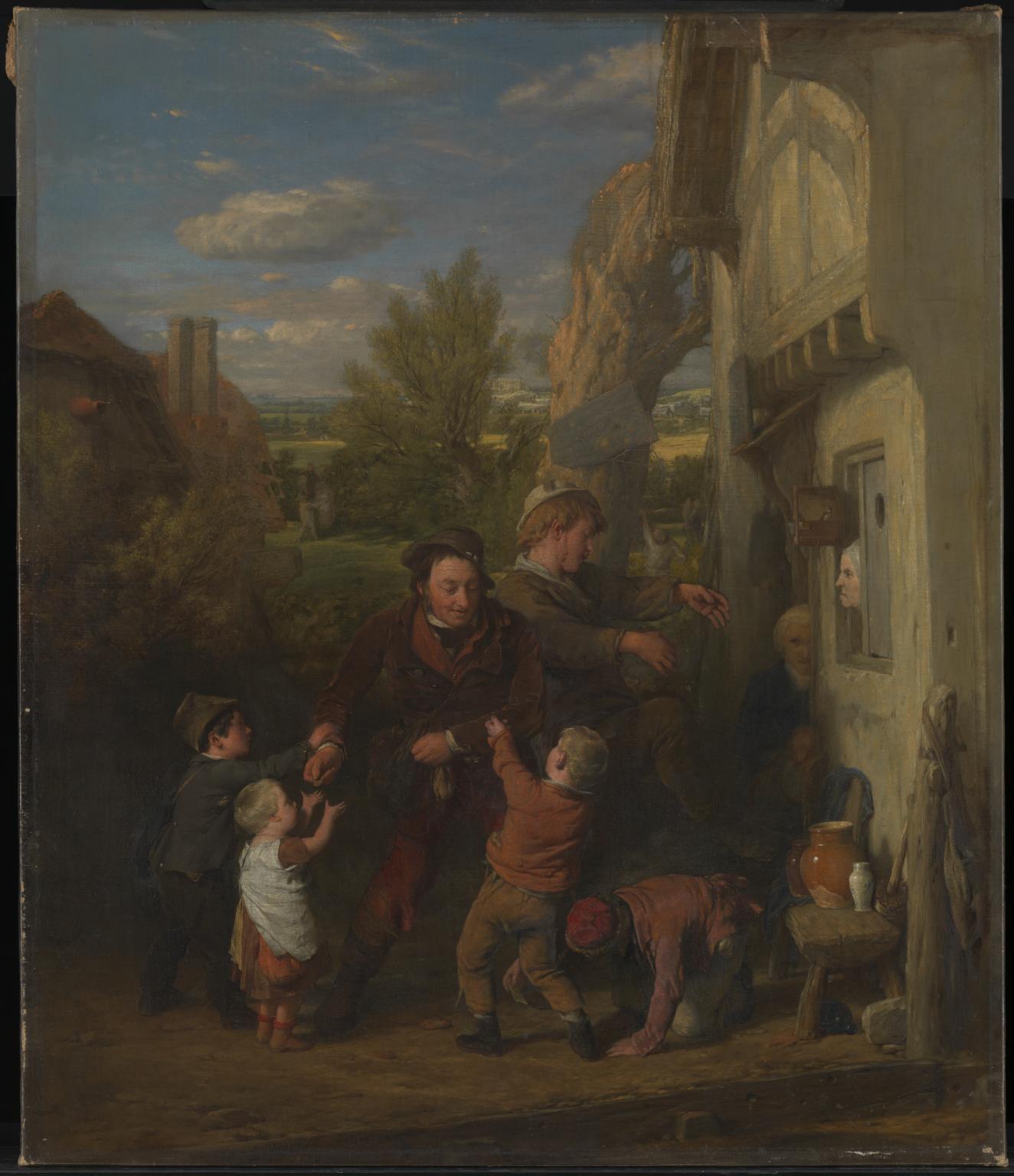
Fair Time (‘Returning from the Ale-House’)
- Artist: William Mulready
- Date: 1809–1839, exhibited 1809, 1840
- Medium: Oil paint on canvas
- Dimensions: support: 787 x 660 mm
- Museum: Tate Britain
- Collection record: Tate Britain website
Listen to the free audio guide
In the museum now? Point your phone at the next artwork and hear its guide.
About this artwork
This is the "Fair Time" (formerly "Returning from the Ale‑House") by William Mulready. Oil on canvas, painted between 1809 and 1839, it first appeared at the Royal Academy in 1809 under its original title. The scene is a light‑hearted snapshot of village life: a handful of children scramble for coins from two ruddy‑cheeked men staggering out of an ale‑house, while a dour schoolmaster watches from a nearby cottage. The background shows a tranquil, wooded landscape bathed in evening light, echoing the Dutch genre scenes of Van Ostade that influenced Mulready and his contemporary David Wilkie.
When Mulready displayed the work, the depiction of drunkenness sparked outrage from a society increasingly alarmed by the Temperance movement. Critics decried the scene as vulgar, leading Mulready to revise the painting. In 1840 he redrew the background, brightened the foreground, and retitled it "Fair Time", softening the shock value and aligning it with the more genteel tastes of the era. The reworked version was well received, eventually acquired by collector Robert Vernon for £420 before being presented to the nation in 1847. The piece remains a vivid commentary on rural life, public morality, and the evolving aesthetic of early nineteenth‑century Britain.
See it in person
Fair Time (‘Returning from the Ale-House’) is in the collection of Tate Britain on Millbank, London — free to enter. Point your phone at any artwork there and audioguide.london plays a free audio guide in six languages — no app download needed.