Edward Carpenter
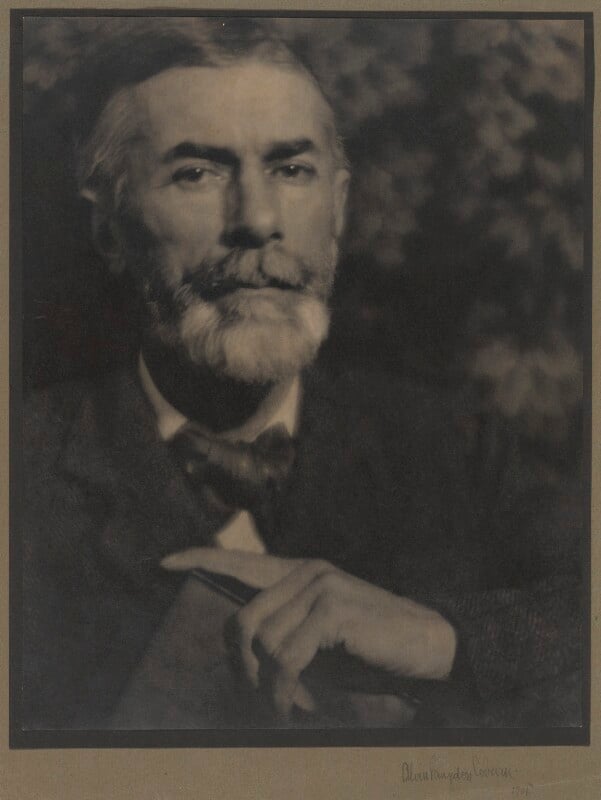
- Artist: Alvin Langdon Coburn
- Date: 1905
- Medium: gum platinum print
- Dimensions: 11 1/8 in. x 8 3/4 in. (283 mm x 222 mm)
- Portrays: Edward Carpenter
- Museum: The National Portrait Gallery
- Collection record: The National Portrait Gallery website
Listen to the free audio guide
About this artwork
In front of you sits a small yet striking portrait of Edward Carpenter, captured by Alvin Langdon Coburn in 1905. The image is a gum‑platinum print: one emulsion made from platinum salts gives the picture its deep, subtle tonality, while a second layer of photosensitized gum Arabic adds just a hint of color to the figure’s face and clothing. Notice how Coburn has set Carpenter at a slight angle, his eyes looking forward; the delicate shading follows the natural contour of the head, making him feel almost three‑dimensional.
Carpenter was an early writer on social subjects—a socialist poet who also campaigned for homosexual rights and lived openly with fellow artist George Merrill from 1898. The portrait was taken in Bloomsbury, London; Coburn had recently settled in England after studying in New York with Gertrude Käsebier and Edward Steichen. His technique of printing two emulsions in perfect registration gives the work a gentle tonal range that feels both intimate and formally precise. This small canvas—just over eleven inches tall—offers a quiet, almost conversational glimpse into an early twentieth‑century thinker’s face.
See it in person
Edward Carpenter is in the collection of The National Portrait Gallery at St Martin's Place, London — free to enter. Point your phone at any artwork there and audioguide.london plays a free audio guide in six languages — no app download needed.