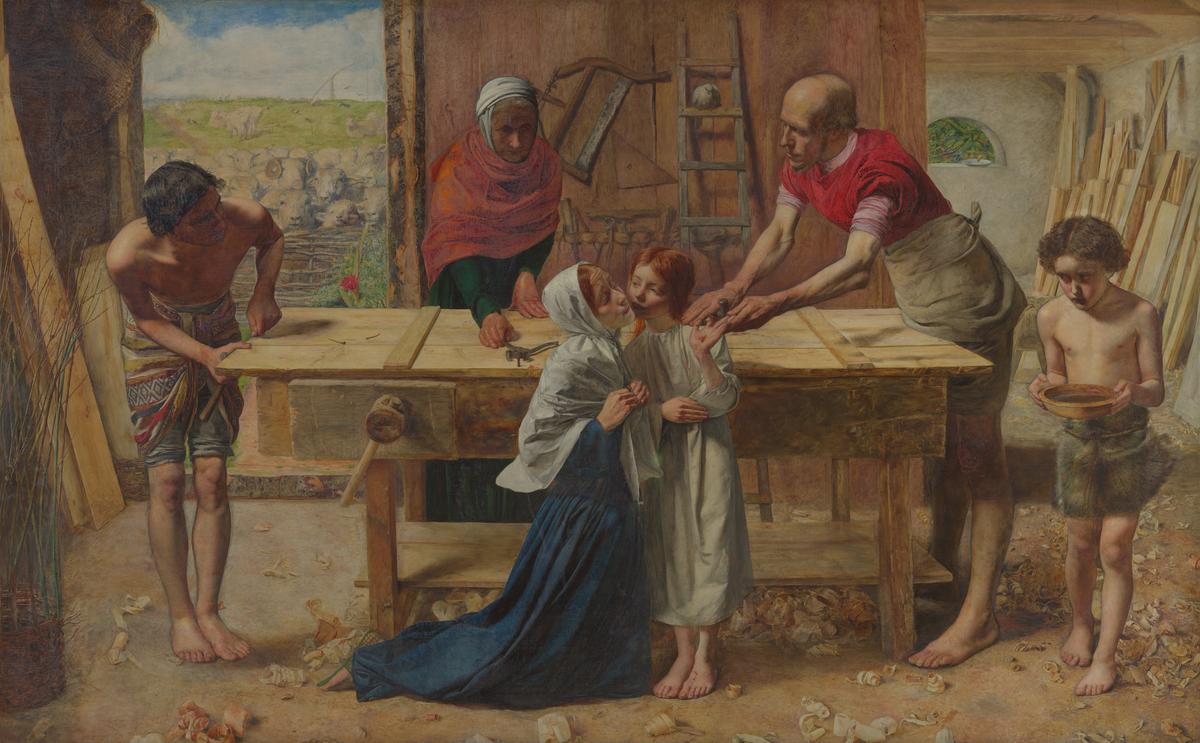
Christ in the House of His Parents (‘The Carpenter’s Shop’)
- Artist: Sir John Everett Millais, Bt
- Date: 1849–50
- Medium: Oil paint on canvas
- Dimensions: support: 864 x 1397 mm
- Museum: Tate Britain
- Collection record: Tate Britain website
Listen to the free audio guide
About this artwork
This is *Christ in the House of His Parents* by Sir John Everett Millais, Bt, painted in 1849‑50. It’s his first major religious work, set in a real‑life carpenter’s workshop on Oxford Street. Millais packed the scene with symbols pointing to the crucifixion: a carpenter’s triangle above the family marks the Holy Trinity; wood and nails lie on the table; and the young Jesus’ blood‑stained hand and foot echo the nail wounds He would later suffer. A white dove perched on the ladder represents the Holy Spirit. The figures are ordinary, working people: Joseph is modeled on the artist’s own father, Mary on his sister‑in‑law, St John the Baptist on a young cousin, and Christ himself on a local friend’s son.
The painting sparked a media firestorm. The Times called it revolting and Dickens blasted it as a “hideous, wry‑necked, blubbering, red‑haired boy in a night‑gown.” Despite the backlash, Millais’ meticulous detail and commitment to truth‑to‑nature earned him a place among the Pre‑Raphaelites. The scene captures both the humble reality of the family’s life and the foreshadowing of the Passion in vivid, almost graphic detail.
See it in person
Christ in the House of His Parents (‘The Carpenter’s Shop’) is in the collection of Tate Britain on Millbank, London — free to enter. Point your phone at any artwork there and audioguide.london plays a free audio guide in six languages — no app download needed.