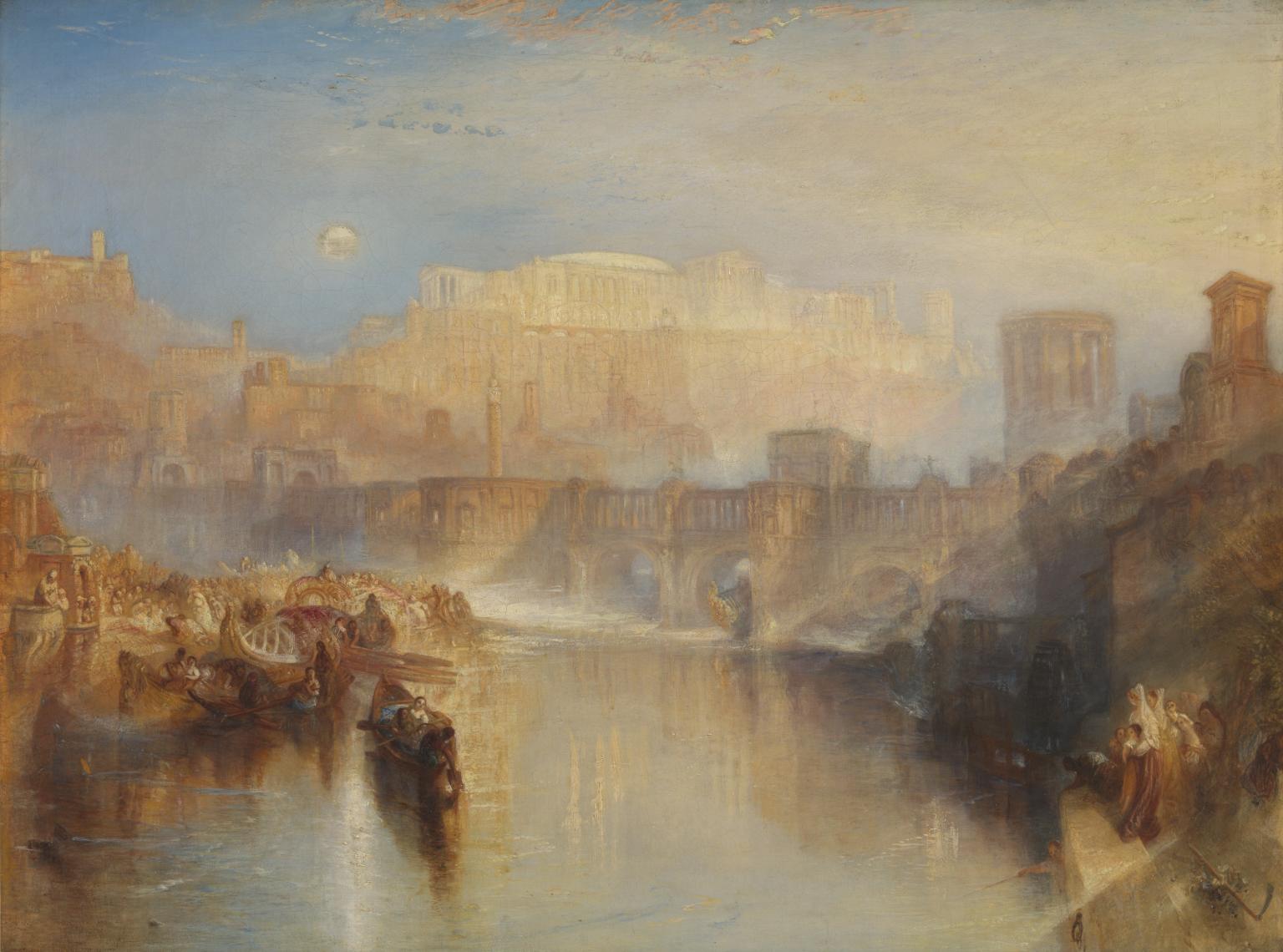
Ancient Rome; Agrippina Landing with the Ashes of Germanicus
- Artist: Joseph Mallord William Turner
- Date: exhibited 1839
- Medium: Oil paint on canvas
- Dimensions: support: 914 x 1219 mm
- Museum: Tate Britain
- Collection record: Tate Britain website
Listen to the free audio guide
About this artwork
This is the “Ancient Rome; Agrippina Landing with the Ashes of Germanicus” by Joseph Mallord William Turner. In it, Turner blends his keen eye for Roman ruins with a poetic imagination. The city rises from a misty veil, a glowing mass of marble that fades into the distance, giving the scene an almost dreamlike quality. Overlaying that skyline is a tender tale of devotion: Agrippina, the widow of the famed general Germanicus, carries his ashes back to Rome in a bronze urn, and the scene is crowded with mourners who greet her on her arrival. Turner’s brushwork captures the soft light of a setting sun reflecting off the Tiber, while the palette of blues, reds, and golds evokes the warmth of an ancient dawn. The painting was first shown in 1839, a time when Turner was already celebrated for his atmospheric landscapes. It later entered the national collection as part of the Turner Bequest in 1856. The work is a striking example of how Turner could merge historical narrative with a poetic rendering of light and atmosphere.
See it in person
Ancient Rome; Agrippina Landing with the Ashes of Germanicus is in the collection of Tate Britain on Millbank, London — free to enter. Point your phone at any artwork there and audioguide.london plays a free audio guide in six languages — no app download needed.