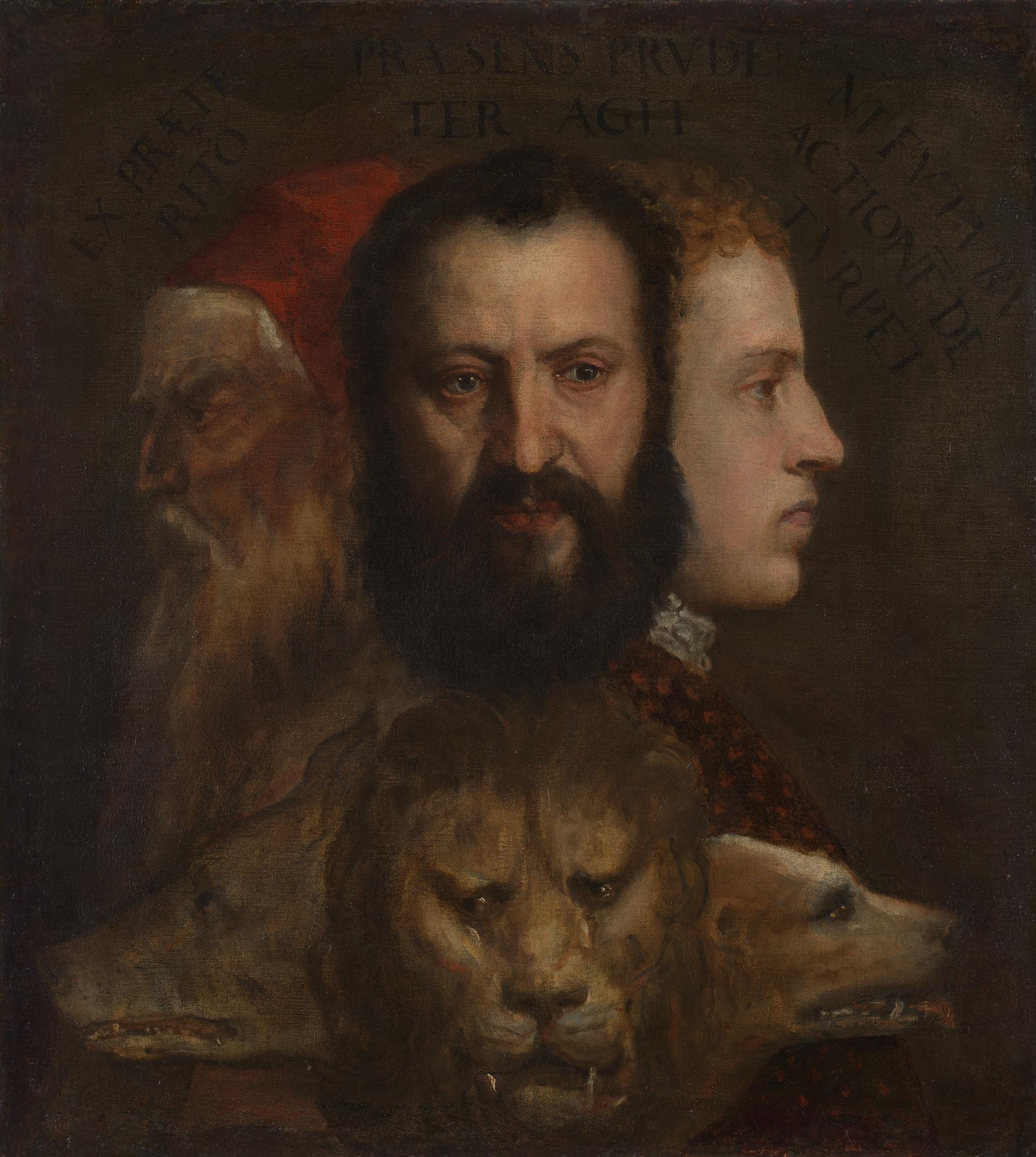
An Allegory of Prudence
- Artist: Titian
- Date: about 1550
- Medium: oil on canvas
- Museum: The National Gallery
- Collection record: The National Gallery website
Listen to the free audio guide
About this artwork
This is the "An Allegory of Prudence" painted in the Italian north by Titian. The Latin inscription above the three animal heads translates as: ‘Learning from Yesterday, Today acts prudently lest by his action he spoil Tomorrow.’ This painting has been the subject of much debate about its meaning and purpose.
The composition was extensively revised during painting, with the animal heads added at a late stage and fairly summarily executed. The execution of the heads is of varied finish and quality, with the central one being the most subtle and vibrant. Some observers have suggested that a studio assistant may have been involved in the addition of these heads.
Despite its unusual composition, the painting's style is consistent with Titian's work from the late 1540s. The lighting from the right side is also noteworthy, as it's unusual for a right-handed artist like Titian to paint this way. This has led some to suggest that the painting was made for a specific location and intended to be seen from afar.
Some theories about the painting's meaning include its possible connection to the concept of Prudence, or even its autobiographical nature, representing Titian, his son Orazio, and nephew Marco Vecellio. However, these interpretations are still a topic of debate among art historians.
See it in person
An Allegory of Prudence hangs in The National Gallery on Trafalgar Square, London — free to enter. Point your phone at any artwork there and audioguide.london plays a free audio guide in six languages — no app download needed.