Allegory of the Continent of Asia
- Artist: Franz Anton Maulbertsch
- Date: around 1750
- Medium: oil on canvas
- Museum: The National Gallery
- Collection record: The National Gallery website
Listen to the free audio guide
About this artwork
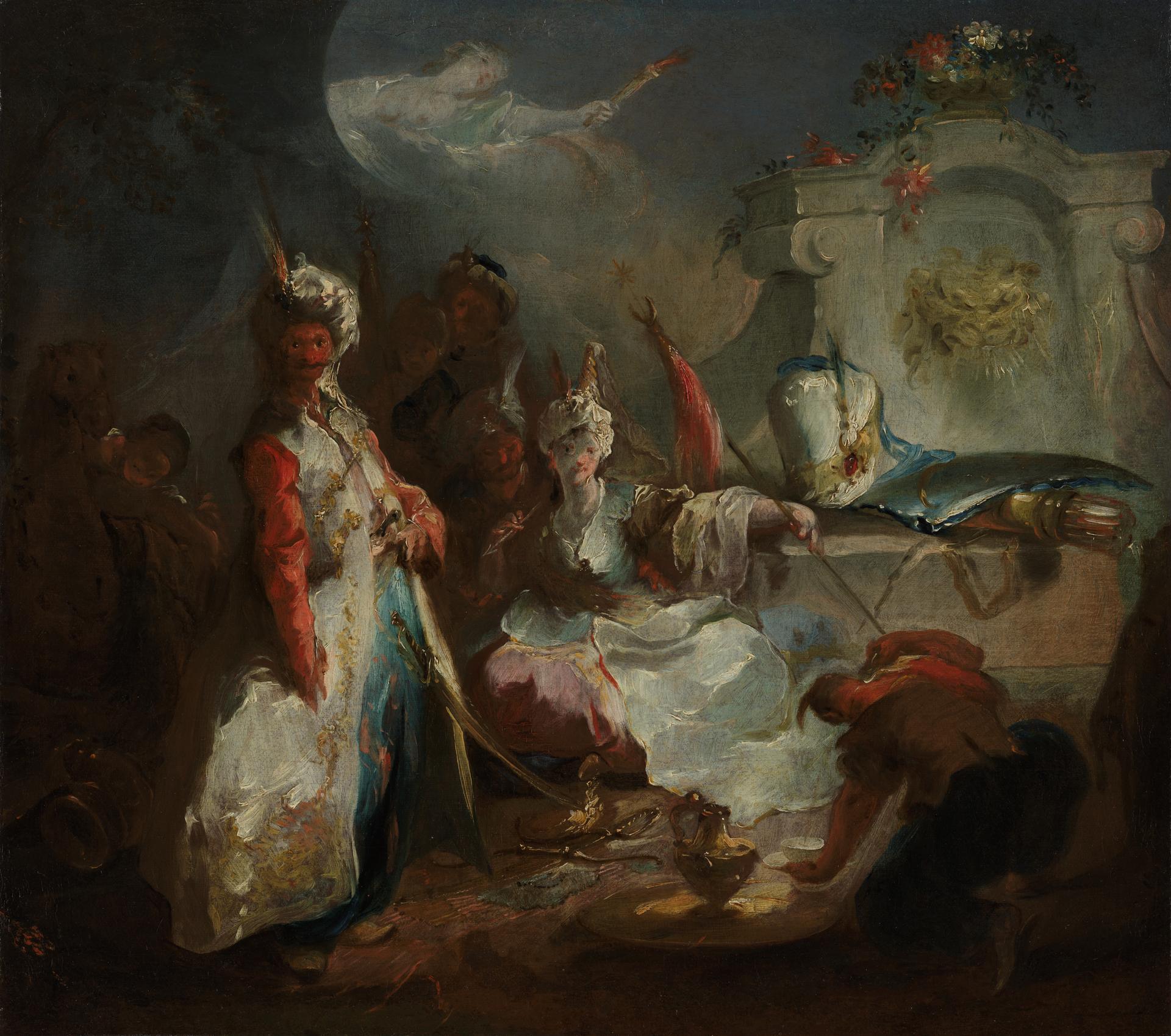
This is "Allegory of the Continent of Asia" by Franz Anton Maulbertsch. Painted in the early 18th century, it's a beautiful representation of the Orient - or what we would now call the countries of Eastern Europe and Western Asia.
Notice how the turbaned woman holds a pole topped with a crescent moon and star, symbols of the powerful Ottoman Empire that dominated much of the region at the time. She's accompanied by a man who wears a white turban and a magnificent coat, and figures with a camel appear in the darkness on the left.
Above them, Venus shines brightly as the morning star, another reference to the Orient. This scene is typical of 18th-century depictions of the four continents - Asia, Europe, America, and Africa. While we don't know if this painting was part of a series, it's likely that Maulbertsch was drawing inspiration from other works like this.
Despite its spontaneous brushwork, this oil sketch is actually a finished work, painted around 1750 by one of the most important artists of the Austrian School. Maulbertsch's use of colour and paint application is remarkably expressive, comparable to that of Giovanni Battista Tiepolo, who also depicted Asia in his famous ceiling fresco in Würzburg, Germany.
See it in person
Allegory of the Continent of Asia hangs in The National Gallery on Trafalgar Square, London — free to enter. Point your phone at any artwork there and audioguide.london plays a free audio guide in six languages — no app download needed.