A Woman
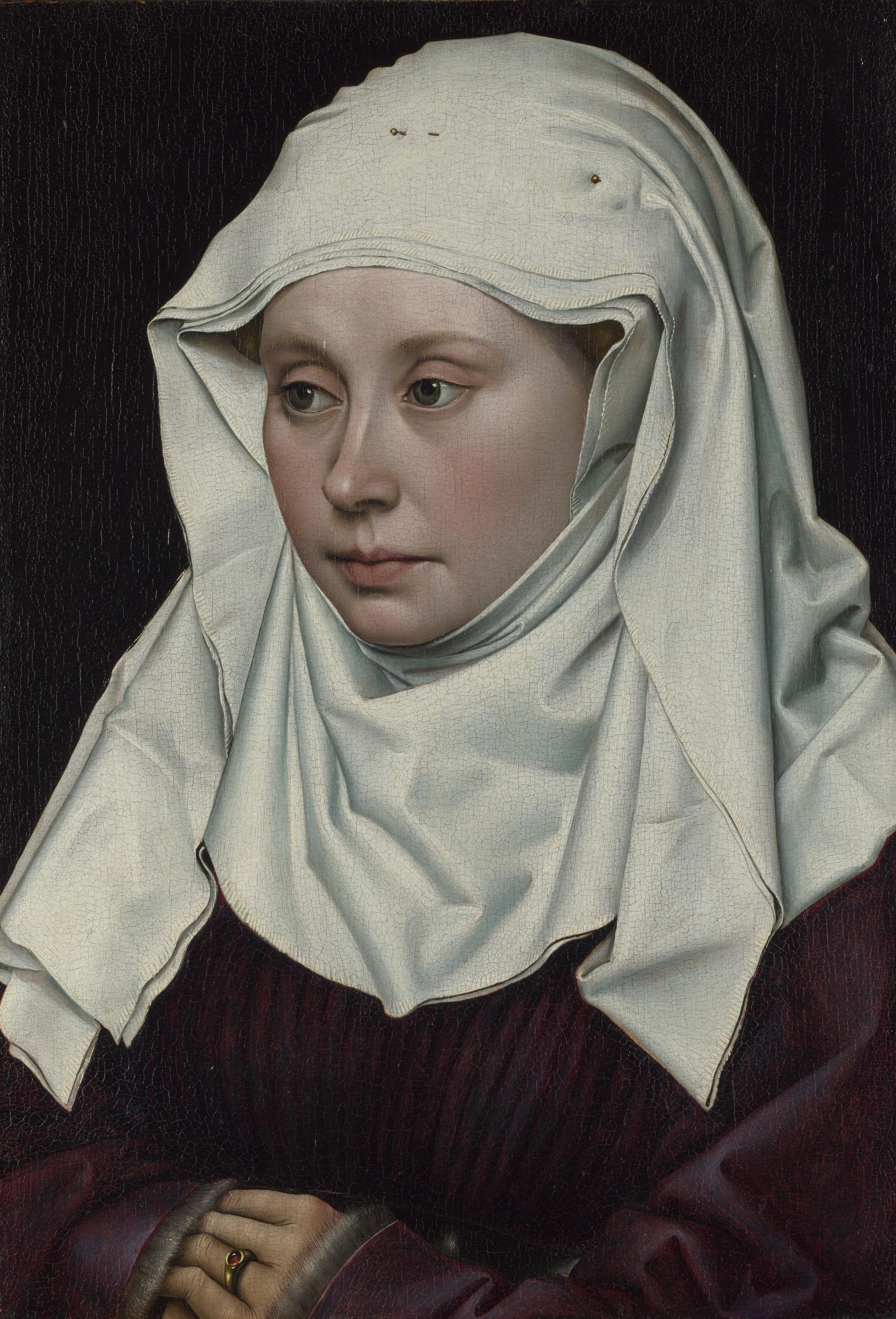
- Artist: Robert Campin
- Date: about 1435
- Medium: oil on wood
- Museum: The National Gallery
- Collection record: The National Gallery website
Listen to the free audio guide
About this artwork
This is "A Woman" painted in the Burgundian tradition by Robert Campin. Painted around 1435, it's an oil on wood portrait of a woman and her husband. The couple were clearly married and their clothes suggest they were prosperous townsfolk from Tournai where Campin lived and worked.
The artist has conveyed not just what they looked like but also their personalities and relationship. The woman appears younger than her husband, more forceful and optimistic. Her skin is smooth, and her bright, wide-open eyes curve up at the corners, a movement echoed by the crisp folds of her headdress.
Campin has placed the woman's near eye in the centre of her panel so that she dominates the composition. The artist used subtle geometric patterns to reinforce his characterisation of each sitter, and lit them in different ways. This is an example of how Campin exploited the technical possibilities of slow-drying oil paint to create such a detailed and expressive portrait.
The woman's clothes are rich but not excessively so, suggesting they were well-off but not aristocratic. Her headdress is particularly interesting as it was manipulated into geometrical folds by the artist. Infrared reflectograms and X-rays reveal how Campin adjusted the headdress to echo the rising lines of her face.
See it in person
A Woman hangs in The National Gallery on Trafalgar Square, London — free to enter. Point your phone at any artwork there and audioguide.london plays a free audio guide in six languages — no app download needed.