A Sea-Shore
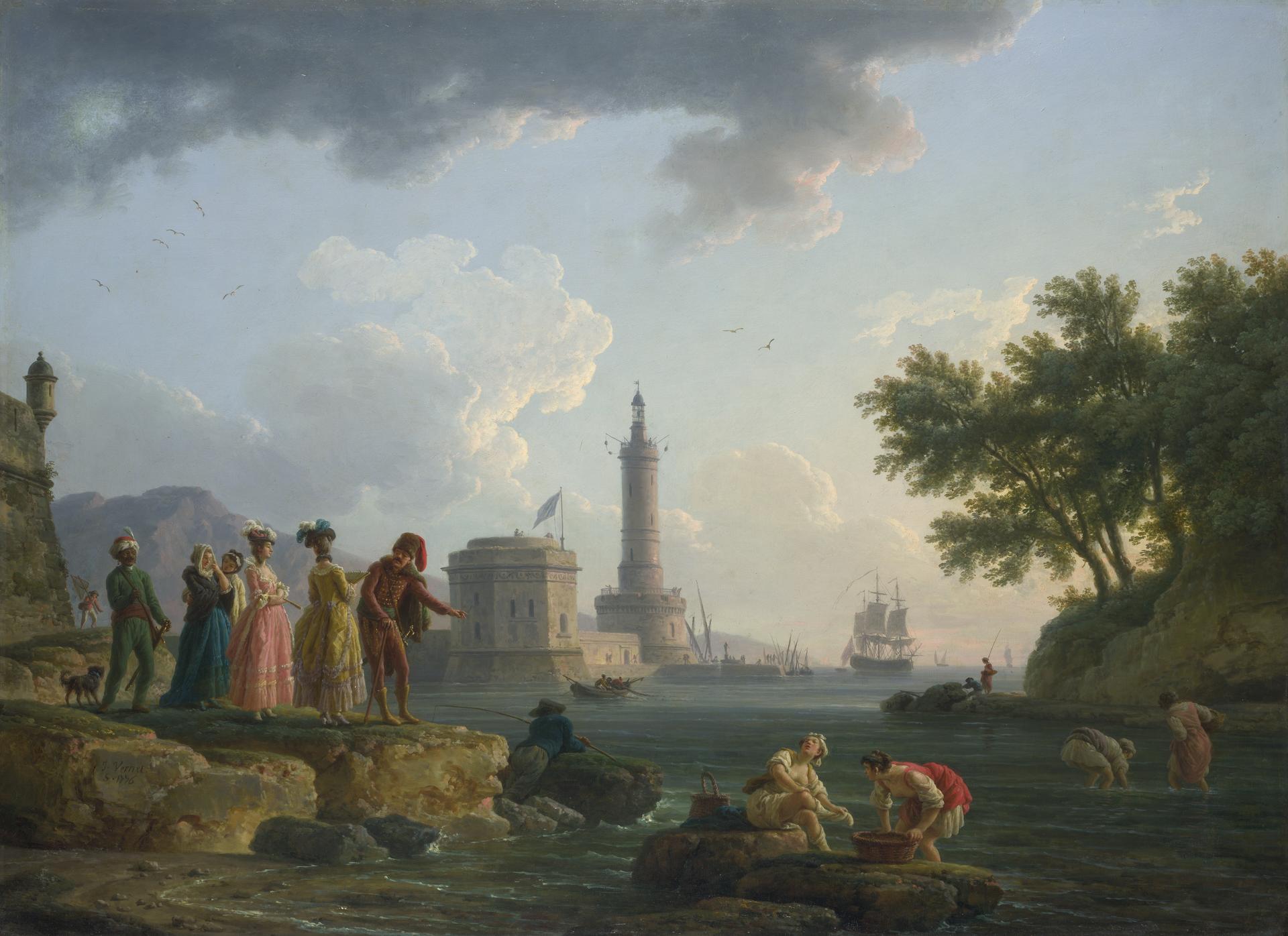
- Artist: Claude-Joseph Vernet
- Date: 1776
- Medium: oil on copper
- Museum: The National Gallery
- Collection record: The National Gallery website
Listen to the free audio guide
About this artwork
This is "A Sea-Shore" by Claude-Joseph Vernet. Painted in 1776, it's an Italian coastal scene bathed in soft sunlight. The painting's main subject isn't the figures, but rather the atmospheric effects of light, air, cloud and water.
As you can see, there are several people in this scene. A Hungarian hussar has brought two fashionably dressed ladies down to the shore. He's drawing their attention either to a large ship entering the harbour or to women gathering shrimps further along the beach. The ladies are followed by two more modestly dressed women and a dark-skinned Moor wearing a turban.
Vernet was influenced by the port scenes of Claude, but his own work adds a picturesque human detail that's really striking here. Take a look at the lighthouse in the background - it's loosely based on one Vernet drew near Naples back in 1750. The harbour view itself is imaginary, but that doesn't detract from the sense of atmosphere and light in this painting.
What I find particularly interesting is the contrast between the elegant ladies on the shore and the women gathering shrimps, who are shown with their skirts hitched up and muscular physiques. And then there's the hussar himself - he's a bit of an enigma, drawing attention to something but it's unclear what exactly.
The painting's very smooth surface and bright colours must have been just what Vernet's patron, the comte du Luc, was looking for when he commissioned this work. It's a truly beautiful piece, capturing the essence of the Italian coast in 1776.
See it in person
A Sea-Shore hangs in The National Gallery on Trafalgar Square, London — free to enter. Point your phone at any artwork there and audioguide.london plays a free audio guide in six languages — no app download needed.